...

Integrating Validation into Agile Development: Bridging the Gap Between IT and QA

Table of Contents

Author

Omer Cimen

CEO & Co-Founder

Share

Integrating Validation into Agile Development: Bridging the Gap Between IT and QA

For years, the pharmaceutical industry and software development teams spoke different languages. IT wanted “Agile”—fast sprints, iterative releases, and breaking things to fix them faster. QA wanted “Waterfall”—heavy documentation, sequential phases, and zero risk.

As pharma goes digital, these two worlds are colliding. The challenge is: How do we integrate validation into Agile without killing the speed that makes Agile valuable?

The “Done” Definition Issue

In typical software development, a feature is “Done” when the code is written and passes peer review. In Pharma, a feature isn’t “Done” until it is validated, documented, and approved. Waiting until the end of a project to validate (the traditional way) creates a massive bottleneck. The solution is to shift validation left—making it part of the sprint itself.

Steps to Bridge the Gap

  1. Validation Stories within Sprints

Don’t treat validation as a separate phase. Include validation activities as tasks within your user stories. For every feature developed, there should be a corresponding validation task. This ensures that your Validation Lifecycle Management (Link: https://validfor.com/validation-lifecycle-management/) moves in parallel with code development, not miles behind it.

  1. Traceability is Key

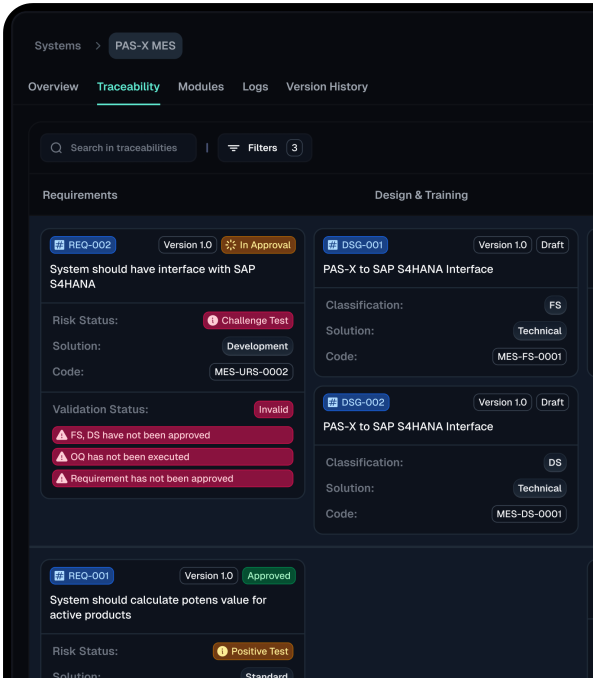
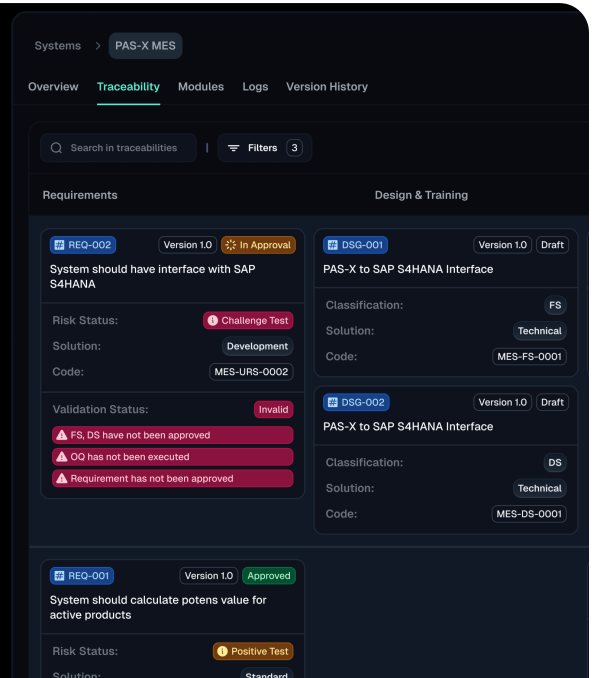
Agile moves fast, and documentation can easily get lost in the shuffle. If a user requirement changes in Sprint 3, does your test case in Sprint 5 reflect that? You need a system that links requirements, risks, and tests dynamically. When a bug is found during a sprint, it should be logged not just as a coding error, but handled through a proper Deviation Management (Link: https://validfor.com/deviation-management/) process if it impacts critical GxP functionality.

  1. Automate Execution

Agile relies on Continuous Integration/Continuous Deployment (CI/CD). Your validation needs to plug into this pipeline. Instead of writing manual test scripts on paper, use digital Test Management (Link: https://validfor.com/test-management/) tools that can execute tests automatically every time a build is deployed. This provides instant “objective evidence” for your validation report.

  1. AI as the Bridge

One of the newest ways to align IT and QA is using Artificial Intelligence. AI can analyze code changes and predict which validation tests need to be run, saving massive amounts of time. Tools powered by Validfor AI (Link: https://validfor.com/validfor-ai/) can help identify risks in real-time, satisfying both the developer’s need for speed and the QA manager’s need for compliance.

The Cultural Shift

Integrating validation into Agile isn’t just about tools; it’s about culture. IT needs to understand that documentation is not “overhead”—it’s the product. QA needs to understand that “perfect” shouldn’t be the enemy of “good and iterative.”

By embedding validation tools into the development workflow, you stop being the “Department of No” and start being the “Department of Safe Speed.”

Visual representing software validation processes

Computerized System Validation: What It Is and How to Validate a System

  Computerized system validation is the backbone of safe,..

Data Integrity in Pharmaceutical Industry

Understanding Data Integrity in the Pharmaceutical Industry

Data Integrity Policy for Pharmaceutical Industry is a set..

Visual representing data integrity and compliance

The Importance of ALCOA Principles in Pharma

ALCOA principles are the five pillars, Attributable, Legible, Contemporaneous,..

You’re all set!

We’ll reach out shortly to schedule a time