Table of Contents
ToggleAutomated Validation Testing: How Life Sciences Teams Scale CSV Without Compromising Compliance
Automated validation testing is becoming a practical priority for life sciences organizations facing growing validation workloads, faster system change, and rising expectations for audit readiness. As regulated teams manage ERP, MES, LIMS, CTMS, cloud applications, and connected digital workflows, traditional document-heavy CSV approaches are becoming harder to scale efficiently. At the same time, automation is often misunderstood. In regulated environments, the goal is not to replace validation expertise with automation. The goal is to reduce repetitive work, improve consistency, strengthen traceability, and keep human accountability firmly in place. When used strategically, automated validation testing can help life sciences teams move faster without weakening compliance. The most effective approach is not automation for its own sake. It is automation embedded within a controlled digital validation lifecycle where requirements, risks, testing, evidence, approvals, deviations, and change activities remain connected and reviewable.Why Automated Validation Testing Matters in Life Sciences
Computerized system validation has long relied on extensive documentation and manual test execution. That model becomes increasingly difficult to sustain when organizations are validating more systems, supporting more integrations, and handling more frequent changes across regulated environments. Manual validation processes often create pressure in three key areas:- skilled resources spend too much time on repetitive execution and documentation
- evidence capture becomes inconsistent across teams and projects
- release cycles slow down because validation becomes an administrative bottleneck
Automated Testing vs. Validation Automation
A common source of confusion is the assumption that automated testing and validation automation mean the same thing. They do not.What is automated testing?
Automated testing refers to the automated execution of predefined test cases. It is primarily focused on running tests more efficiently and consistently.What is validation automation?
Validation automation is broader. It covers how validation work is managed across the lifecycle, including:- requirements traceability
- risk assessment
- test design and execution
- evidence capture
- review and approval workflows
- deviation management
- change impact tracking
Where Automated Validation Testing Delivers the Most Value
Automated validation testing works best when the activity is repeatable, rules-based, and vulnerable to manual inconsistency. High-value use cases often include:Regression testing
Regression testing is one of the clearest candidates for automation. When core workflows must be revalidated after changes, automated execution helps teams test more frequently and with greater consistency.Access and permission checks
User roles, permissions, and access controls often follow predictable patterns. These checks can be automated to reduce manual effort and improve repeatability.Data verification
Automated validation testing is especially useful when teams need to verify expected data outputs, field mappings, calculations, or system responses across standard scenarios.Repeatable workflow testing
Systems with stable, repeatable process flows are often well suited for automated execution, particularly when those processes need to be validated repeatedly after updates. By automating these structured scenarios, teams can reduce repetitive work while improving testing consistency and earlier issue detection.Why Traceability Matters More Than Speed Alone
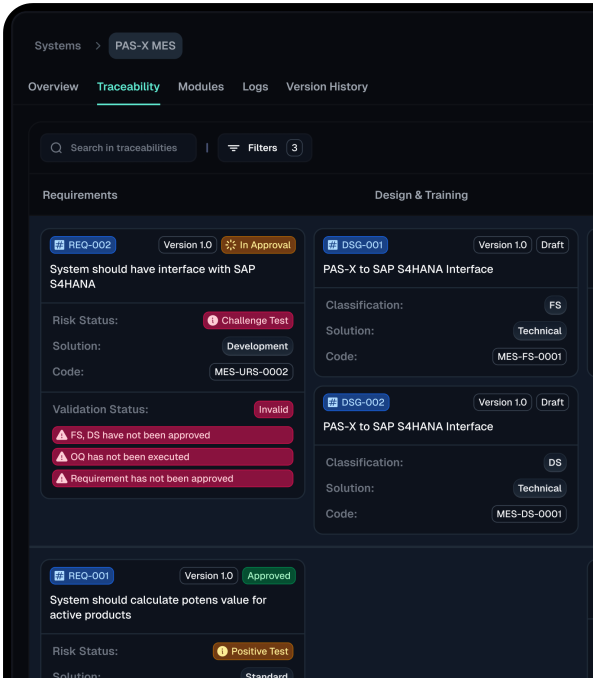
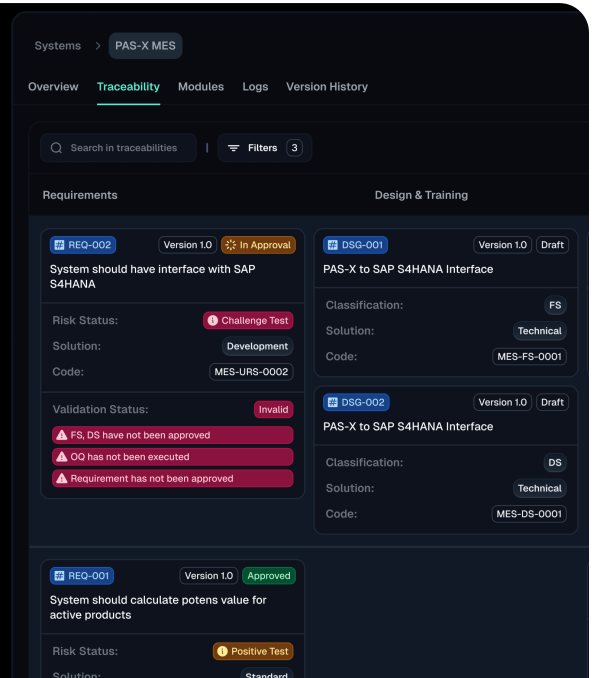
Speed is attractive, but traceability is what creates lasting compliance value. In regulated environments, validation is not only about whether a test passed. It is about whether teams can clearly show what was required, what was tested, what evidence was captured, who reviewed the result, and how the final decision was made. That is where automated validation testing becomes much more powerful when it is part of a broader digital validation process. A strong validation framework should help teams maintain clear links across:- requirements
- risks
- test cases
- execution results
- deviations
- approvals
- release decisions
Why Manual Validation Still Matters
Automation does not remove the need for professional judgment. Validation in life sciences is a compliance and risk-management discipline. It requires teams to assess intended use, understand process context, evaluate risk, review exceptions, and make documented decisions about fitness for use. These responsibilities remain fundamentally human. Activities that still depend on expert oversight include:- defining validation strategy
- assessing business and patient risk
- deciding what should and should not be automated
- reviewing deviations and failures
- approving validation outcomes
- determining whether a system is fit for intended use
How to Implement Automated Validation Testing Effectively
Successful implementation starts with governance, not just tooling. Organizations need to decide where automation adds meaningful value, how results will be documented, and how automated activity will remain controlled over time. The strongest programs treat automation as part of the validation operating model, not as a side initiative.Use a risk-based approach
Not every test should be automated. Teams should prioritize scenarios that are stable, repeatable, and time-consuming when executed manually. Exploratory or judgment-heavy activities may still be better handled through manual review.Build traceability into the process
Automation should connect to requirements, risks, evidence, deviations, and approvals. If automated tests live in isolation, the compliance burden simply shifts elsewhere.Define evidence capture upfront
Evidence should be captured by design, not reconstructed later. Screenshots, logs, timestamps, execution records, and reviewer actions should be stored in a structured, reviewable way.Maintain review and approval controls
Automated execution does not remove the need for review. Validation records still require appropriate signoff, accountability, and auditability.Plan for ongoing maintenance
Automated validation testing is not a one-time setup. Scripts and workflows must be maintained as systems, configurations, and business processes evolve.Compliance Expectations for Automated Validation Testing
Automation does not lower the bar for compliance. In many cases, it raises the need for clear structure and well-defined controls. Any system used to generate, manage, or store validation evidence should support:- secure electronic records
- attributable actions
- audit trails
- controlled access
- version control
- reviewable approvals
Common Challenges and Limitations
Automated validation testing delivers clear benefits, but teams should approach it realistically. Common challenges include:Upfront design effort
Building an automation framework requires planning, structure, and alignment across validation, quality, and technical teams.Script maintenance
Automated scripts must evolve as systems change. Without ownership and lifecycle discipline, automation can become brittle over time.Skill readiness
Some tools require scripting knowledge, while others offer lower-code approaches. The chosen model should match the team’s capabilities and operating style.Organizational resistance
Teams used to traditional CSV methods may be cautious about automation. That concern is understandable in regulated environments and should be addressed through governance, training, and clear process design. Automation does not eliminate validation effort. It redistributes it toward better-controlled, more scalable work.The Future of Automated Validation Testing
As digital validation matures, organizations are moving beyond simple execution automation toward broader lifecycle control. That shift includes better evidence management, stronger traceability, and more structured coordination between validation activities. AI is also beginning to influence validation workflows, especially in areas such as structured content generation, test support, and data analysis. In regulated environments, these capabilities will only create value when they remain transparent, reviewable, and governed by human oversight. The future is not about removing people from validation. It is about giving skilled teams better systems for managing validation at scale.Conclusion
Automated validation testing can help life sciences teams scale CSV more effectively, reduce repetitive manual effort, and improve validation consistency. But its value depends on how it is implemented. The strongest results come when automation is embedded within a controlled digital validation lifecycle that supports traceability, evidence capture, approvals, change management, and human review. That is the difference between faster testing and stronger validation. For life sciences organizations, the path forward is not manual versus automated. It is controlled digital validation, where automation supports compliance, improves efficiency, and helps teams stay audit-ready as complexity grows.
Burak Ozturkmen
Head of Business Development
Share