Maintaining data integrity is no longer just a technical concern for IT or quality teams. In life sciences, it is a business-critical capability that directly influences compliance, operational performance, decision-making, and stakeholder trust. When data is accurate, complete, consistent, and attributable, organizations can move with confidence. When it is fragmented, unreliable, or poorly controlled, the consequences can spread quickly across validation, quality, manufacturing, and regulatory operations.
In regulated environments, data does more than support reporting. It underpins release decisions, deviation management, audit readiness, risk assessments, and ongoing system oversight. That means maintaining data integrity is not simply about preventing errors. It is about preserving control across the processes that matter most.
As digital ecosystems grow more complex, maintaining data integrity requires more than isolated fixes. It requires structured governance, connected systems, strong validation practices, and a culture that treats reliable data as a strategic asset rather than an administrative afterthought.
Why Maintaining Data Integrity Matters More Than Ever
Life sciences organizations now operate across interconnected applications, cloud systems, laboratory platforms, manufacturing environments, and quality workflows. Data moves between systems more frequently, changes more often, and is used by more stakeholders than ever before.
That creates opportunity, but also risk.
When data integrity is strong, teams can make faster decisions, trust their records, reduce reconciliation effort, and respond more effectively during inspections or audits. When it is weak, even routine operations become harder to manage. Teams question reports, spend time resolving inconsistencies, and struggle to prove that records are complete and reliable.
For regulated organizations, this challenge carries additional weight. Data integrity is closely tied to compliance expectations, especially when electronic records support GxP processes. Gaps in data reliability can affect not only efficiency, but also product quality, patient safety, and regulatory confidence.
Common Challenges in Maintaining Data Integrity
Maintaining data integrity becomes difficult when information is distributed across disconnected systems, manual workarounds, and inconsistent processes.
One common issue is fragmentation. A quality team may rely on one platform, validation records may live in another, and supporting evidence may still be stored in spreadsheets, shared drives, or email threads. Once data is scattered across multiple environments without strong synchronization or governance, inconsistencies become almost inevitable.
Legacy systems can create another layer of risk. Older technologies may lack modern controls for validation, audit trails, access management, or structured data checks. As a result, incomplete, duplicate, or incorrect information may enter operational workflows without being detected early.
Operational complexity also contributes to integrity issues. Frequent change requests, system updates, integrations, and configuration changes all increase the chance of mismatched records, outdated values, or missing links between related data points. Over time, these gaps erode trust in the system and create a heavier administrative burden across the organization.
What Data Integrity Failures Look Like in Practice
Data integrity failures are not always dramatic at first. Often, they begin as small inconsistencies that spread quietly through daily operations.
A validation team may discover that test evidence is stored separately from approval records, making it harder to demonstrate complete traceability during an audit. A quality team may find that different systems show conflicting versions of the same record, leading to delays in investigations or review. A manufacturing or laboratory process may rely on incomplete or outdated entries that create confusion when teams try to reconstruct what actually happened.
Even reporting becomes unstable when data integrity is weak. If dashboards, spreadsheets, and system outputs do not align, decision-makers start spending more time reconciling numbers than acting on them. That slows momentum and reduces confidence at every level.
In regulated environments, these problems do not remain operational for long. They quickly become compliance concerns.
How to Maintain Data Integrity More Effectively
Maintaining data integrity starts with prevention. The strongest organizations reduce risk at the point of data creation rather than waiting to detect problems later.
This begins with structured validation controls. Systems should enforce defined formats, required fields, permitted values, and logic checks wherever possible. When bad data is blocked before it enters the workflow, downstream correction effort drops significantly.
Standardized templates and controlled workflows also make a major difference. When users work within clearly defined forms, processes, and approval paths, the likelihood of inconsistent entries decreases. This is especially important when multiple departments contribute to the same records.
Automated monitoring adds another layer of protection. Alerts for missing fields, unusual values, inconsistent timestamps, or broken process links help teams identify anomalies earlier. Routine reconciliation between related systems can further reduce risk by catching discrepancies before they affect reporting, compliance, or operations.
The goal is not to add more manual checking. It is to design processes where reliable data becomes the default outcome.
The Role of Validation in Maintaining Data Integrity
Validation plays a central role in maintaining data integrity, especially in GxP environments. It is not enough for systems to store data. Organizations need confidence that systems handle data correctly, preserve it accurately, and support reviewable, attributable activity across the record lifecycle.
That means data integrity should be considered throughout validation, not treated as a separate topic. Requirements should define how data must be entered, processed, transferred, stored, reviewed, and retained. Risk assessments should identify where integrity failures would create the greatest impact. Testing should verify that controls work as intended under real operating conditions.
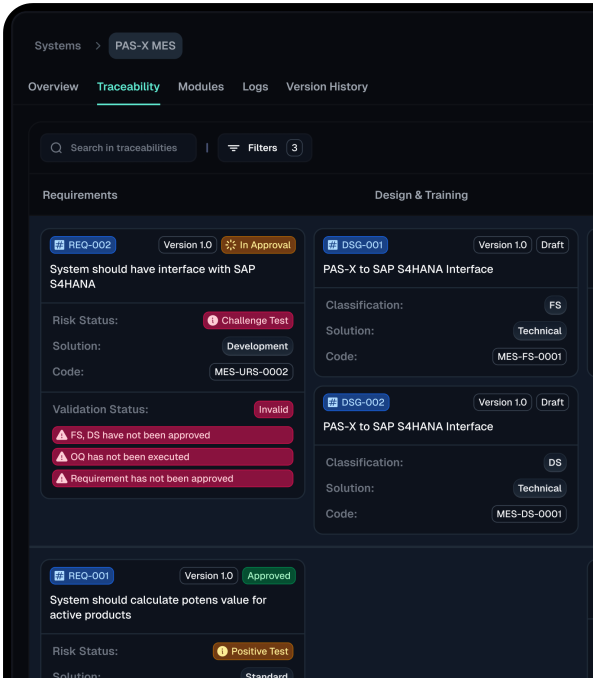
This is where digital validation approaches become especially valuable. When requirements, risks, testing, evidence, deviations, and approvals are connected within a controlled workflow, teams gain stronger visibility into how data integrity is being protected. Instead of chasing records across disconnected systems, they can manage integrity as part of a broader lifecycle process.
Technologies That Support Data Integrity
The right technology does not solve data integrity on its own, but it can make strong practices much easier to sustain.
Governance platforms help organizations define ownership, document policies, and improve visibility into how data moves across systems. Validation and quality platforms can strengthen traceability by linking related records and reducing reliance on manual handoffs. Automated controls within applications can enforce consistent business rules and data requirements before issues spread.
Audit trails are another essential capability. Teams need to understand what changed, when it changed, who performed the action, and whether the change was appropriately reviewed. Without that visibility, data reliability becomes much harder to defend.
Backup, versioning, and recovery capabilities also matter. Integrity is not only about preventing bad data entry. It is also about preserving trustworthy records when systems fail, processes break, or unexpected incidents occur. A resilient environment should support reliable recovery without forcing teams into manual reconstruction.
More advanced monitoring capabilities, including data observability and anomaly detection, can also help organizations spot emerging issues earlier. These tools are most useful when they support structured review and follow-up, not just alert generation.
Why Culture Matters as Much as Technology
Technology can enforce controls, but it cannot create ownership on its own. Maintaining data integrity also depends on organizational behavior.
Teams need to understand why data accuracy matters, how records should be handled, and where responsibility sits when issues arise. Clear documentation standards help reduce ambiguity. Defined data owners or stewards help ensure that important datasets are monitored and governed consistently. Training helps employees recognize risks earlier and follow processes more reliably.
Culture becomes especially important in fast-moving digital environments. When teams are under pressure to move quickly, poor workarounds can creep in quietly. If accuracy is treated as optional or secondary, integrity issues tend to grow in the shadows. If reliable data is treated as a shared responsibility, control becomes much easier to maintain.
Organizations that do this well make data integrity part of daily operating discipline rather than a periodic cleanup effort.
Emerging Trends in Data Integrity Management
As digital operations mature, data integrity practices are becoming more proactive and more continuous.
Automation is helping teams monitor data quality at scale, enforce rules more consistently, and reduce dependence on manual review. Artificial intelligence is beginning to support anomaly detection, pattern recognition, and structured content generation in ways that may help organizations identify issues earlier. In regulated environments, however, these capabilities still need strong governance, transparency, and human oversight.
Another important trend is the move toward connected digital quality and validation ecosystems. Rather than managing records in isolated tools, organizations increasingly want systems that preserve traceability across requirements, tests, evidence, changes, approvals, and operational records. This reduces fragmentation and makes data integrity easier to demonstrate during audits and inspections.
The broader direction is clear. Maintaining data integrity is becoming less about reactive correction and more about building environments where trustworthy data is produced, preserved, and governed by design.
The Strategic Value of Maintaining Data Integrity
Organizations that maintain strong data integrity gain more than cleaner records.
They make better decisions because teams trust the information in front of them. They reduce compliance risk because data is more complete, attributable, and reviewable. They improve efficiency because less time is wasted reconciling systems, correcting errors, or searching for missing evidence. They also strengthen trust with regulators, partners, and customers by demonstrating greater control over critical information.
Over time, this becomes a strategic advantage.
Reliable data supports stronger governance, faster operations, smoother audits, and better long-term scalability. In a regulated industry where documentation quality and system control are closely scrutinized, that advantage is not abstract. It is operationally visible.
Conclusion
Maintaining data integrity is not a one-time initiative or a narrow technical task. It is an ongoing discipline that touches compliance, quality, validation, operations, and decision-making across the organization.
For life sciences teams, the most effective approach combines structured validation, strong system controls, connected workflows, clear ownership, and a culture that values accuracy. When these elements work together, data integrity stops being a recurring problem and becomes a durable source of confidence.
As digital ecosystems continue to expand, organizations that embed data integrity into their daily operating model will be better positioned to scale, stay audit-ready, and turn reliable information into a genuine strategic advantage.