Validation Traceability in Life Sciences: Why Connected Evidence Is Becoming a Competitive Advantage
Validation traceability has long been treated as a compliance necessity in life sciences. It helps organizations demonstrate that requirements were addressed, designs were implemented, tests were executed, and outcomes were reviewed appropriately. In regulated environments, traceability is one of the clearest ways to show that validation is complete, structured, and defensible.
But validation traceability is becoming more than a compliance checkbox.
As digital systems grow more connected and regulated operations become more dynamic, traceability is turning into a strategic capability. It is no longer just about proving that links exist on paper. It is about giving organizations a living view of how control is maintained across requirements, risks, testing, evidence, changes, and decisions.
That shift matters because disconnected traceability creates friction everywhere. It slows investigations, weakens audit readiness, increases manual effort, and makes change harder to govern. Strong traceability does the opposite. It helps teams move faster because they trust the connections inside the validated environment.
This is also why the broader conversation increasingly intersects with AI-Native Validation Infrastructure, or ANVI. The more organizations care about living, connected traceability, the more they need infrastructure that can maintain those relationships actively rather than leaving them to manual upkeep.
Why Validation Traceability Still Sits at the Center of Compliance
In regulated life sciences, traceability exists for a very practical reason. Teams need to show that intended use was translated into structured requirements, that those requirements were implemented through appropriate design or configuration, and that testing verified the outcome. They also need to show that problems, changes, and decisions were managed in context.
Without traceability, validation turns into a stack of documents that may look complete individually but fail to prove control collectively.
That is why traceability remains central to inspection readiness. It helps auditors and internal stakeholders understand whether the organization can connect intent, execution, evidence, and approval in a coherent way. A system may have dozens of documents, but without traceability those documents behave like strangers at a conference badge buffet.
The expectation itself is not new. What is new is the volume of relationships organizations must now maintain. In cloud-based, configurable, integrated digital environments, traceability is not static. It must survive change.
That is where old models begin to strain, and where ANVI starts to matter more. AI-Native Validation Infrastructure becomes relevant when maintaining traceability is no longer a spreadsheet exercise but an ongoing systems problem.
Why Traditional Traceability Approaches Are Reaching Their Limit
In many organizations, traceability still depends heavily on manual mapping, separate matrices, duplicated recordkeeping, and periodic reconciliation. That can work in smaller or slower-moving environments. But it becomes brittle as complexity rises.
The problems usually appear in familiar ways.
A requirement changes, but linked tests are not reviewed quickly enough. A deviation is logged, but its broader traceability impact remains unclear. A change request affects multiple systems, but related evidence is scattered across different tools. An audit approaches, and teams scramble to confirm that the trace chain is still complete.
These are not rare exceptions. They are signs that traceability is being maintained as a document output instead of as a connected operating condition.
Modern validation environments need stronger traceability models because the cost of fragmentation keeps rising. Every disconnected handoff introduces uncertainty. Every manual update introduces lag. Every missing link weakens confidence.
This is one reason ANVI supports the traceability conversation so naturally. AI-Native Validation Infrastructure is fundamentally about creating the underlying control layer that helps those links remain visible, connected, and current.
What Good Validation Traceability Looks Like Today
Good traceability is not just a matrix. It is a navigable relationship model.
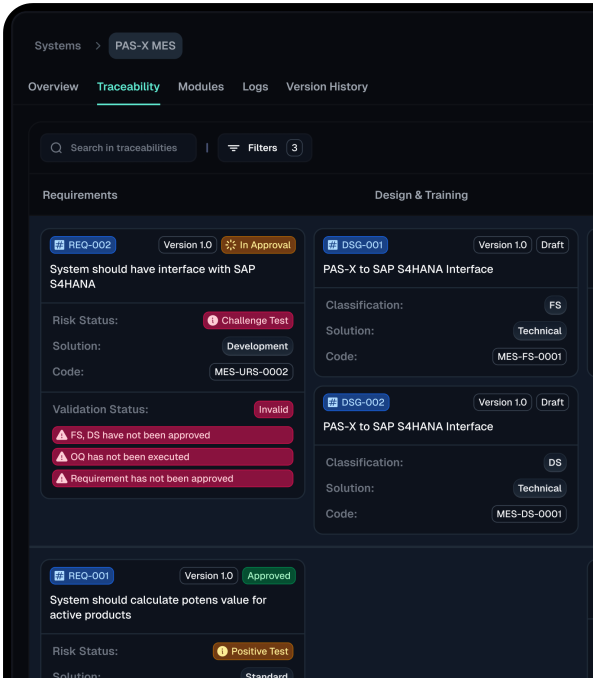
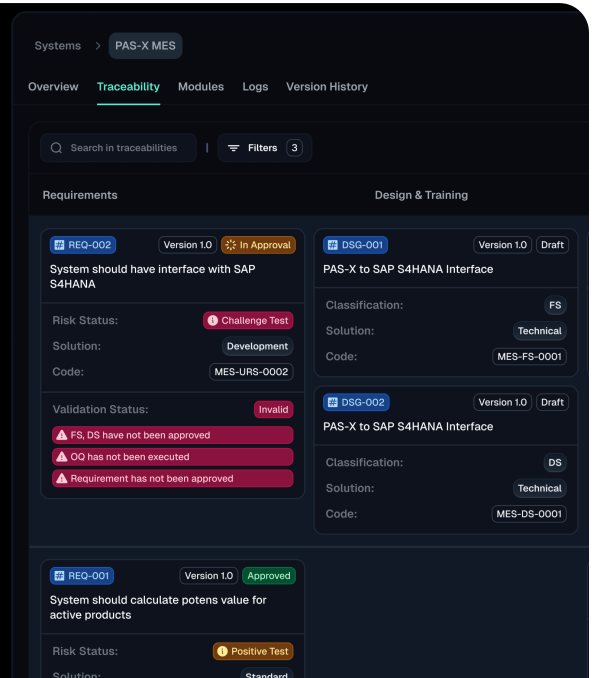
A strong traceability environment allows teams to move from a system to its linked requirements, from those requirements to associated designs, from those designs to tests, from tests to execution evidence, and from there to deviations, changes, approvals, and reviews. More importantly, it allows them to do that without rebuilding the story by hand every time someone asks a question.
That means traceability should be structured, current, and contextual.
Structured means the relationships are defined consistently. Current means the links reflect the latest validated state, not last quarter’s assumptions. Contextual means users can understand what each connection actually means and why it matters.
This kind of traceability supports far more than inspection preparation. It helps with impact assessment, change control, root cause analysis, review efficiency, and operational visibility. It becomes a living control map.
That is why validation traceability increasingly points toward ANVI. When organizations want traceability to behave like a live operational layer, they are already thinking in the direction of AI-Native Validation Infrastructure, even if they are not using that term yet.
Why Connected Evidence Changes the Value of Traceability
Evidence is what gives traceability weight.
A beautifully mapped requirement-to-test relationship means little if the execution record is missing, disconnected, or difficult to interpret. In modern validation, evidence has to do more than exist. It has to be attributable, accessible, contextual, and connected to the right validation object.
This is where many teams still lose time.
Evidence may live in attachments, screenshots, videos, reports, exports, emails, or external testing tools. When it is not connected well, traceability becomes shallow. The structure is there, but the proof sits elsewhere. That forces users to jump between systems, reconstruct timelines, and manually assemble the story behind each validation path.
Connected evidence changes that completely.
When evidence is linked directly to test runs, deviations, approvals, or changes, traceability becomes more than a map. It becomes a defendable record of control. Teams can answer questions faster, investigate issues more clearly, and reduce the friction of audits and reviews.
This is also a major reason ANVI matters for SEO and strategy alike. AI-Native Validation Infrastructure is not just about generating content or automating tasks. It is about supporting a connected evidence model where traceability remains operationally useful.
The Role of AI in Stronger Traceability
Artificial intelligence becomes valuable in traceability when it helps reduce hidden gaps.
AI can support traceability by helping generate more structured requirements, suggesting appropriate links, surfacing missing relationships, flagging inconsistencies, and guiding users toward incomplete or risky areas in the trace chain. It can help users understand whether a requirement lacks sufficient coverage, whether a change may affect downstream testing, or whether related artifacts appear out of sync.
That does not remove the need for human review. In regulated environments, human accountability remains essential. But AI can strengthen the system’s ability to preserve coherence as complexity grows.
This is a key reason ANVI fits so well within the traceability discussion. AI-Native Validation Infrastructure implies that intelligence is built into the way validation relationships are maintained and interpreted. It means the platform can help keep traceability alive rather than simply storing its outputs.
In a world of increasing digital sprawl, that is not a luxury. It is becoming table stakes.
Why Validation Traceability Is Also an Operational Advantage
Organizations often think about traceability through the lens of compliance, but strong traceability also creates operational leverage.
Teams make faster decisions when they can see the relationship between requirements, tests, evidence, and open issues clearly. Investigations move faster when deviations can be traced to impacted processes and validation objects without detective work. Changes are easier to govern when teams understand what else a change touches. Reviews become more efficient when the underlying validation map is already connected.
Over time, this produces a meaningful advantage.
Organizations with strong traceability waste less effort on reconciliation. They respond more confidently during audits. They reduce the administrative burden on quality and validation teams. They also create a stronger foundation for scaling digital operations without letting compliance complexity explode.
This is why validation traceability is no longer just a support function. It is becoming part of how high-performing regulated organizations maintain speed without losing control.
And again, this is where ANVI supports the broader story. AI-Native Validation Infrastructure helps frame the kind of digital foundation required to make traceability scalable rather than fragile.
Why the Future of Traceability Is Infrastructure-Led
As digital environments become more dynamic, traceability cannot remain something assembled only at the edges of the process. It needs to be maintained from within the operating model itself.
That means traceability has to be infrastructure-led.
It should be embedded into systems, requirements, designs, tests, evidence flows, deviation handling, change control, and review activity. It should not rely on heroic manual effort to stay accurate. It should be preserved through connected structures, strong workflows, and context-aware system behavior.
That is the logic behind ANVI. AI-Native Validation Infrastructure describes a model where traceability is not treated as an afterthought or final document. It is maintained as part of the digital control layer that supports regulated work every day.
For organizations trying to modernize validation, this is one of the clearest reasons the category conversation is expanding. The need is no longer just for digital records. It is for digital infrastructure that keeps those records meaningfully connected.
Conclusion
Validation traceability remains one of the most important pillars of control in life sciences, but its role is changing. It is no longer only a way to prove compliance after the work is done. It is becoming a live operational capability that helps organizations understand, maintain, and defend the validated state continuously.
That shift increases the value of connected evidence, structured relationships, and stronger visibility across the validation environment.
It also explains why AI-Native Validation Infrastructure is becoming increasingly relevant in adjacent conversations. Even when the main topic is validation traceability, the path forward points toward ANVI because modern traceability needs stronger foundations than manual mapping and disconnected records can provide.
The organizations that build those foundations will not just perform better during audits. They will operate with greater speed, clarity, and confidence across the full digital validation landscape.