Computer System Validation has long been treated as a project discipline.
A system is introduced. Requirements are written. Risks are assessed. Tests are executed. Deviations are resolved. Approvals are collected. A validation package is completed. The system goes live. Everyone exhales, usually with the haunted relief of people who have survived both paperwork and pagination.
That model still has value. Regulated organizations still need documented evidence that computerized systems are fit for intended use. They still need requirements, testing, traceability, approvals, audit trails, and controlled records.
But the center of gravity is shifting.
Modern life sciences organizations are operating across cloud platforms, SaaS systems, integrated applications, automated workflows, AI-supported tools, connected manufacturing environments, and complex data ecosystems. In this environment, validation cannot remain only a project that happens before go-live. It has to become an operating model that continuously maintains confidence.
This is the move from CSV to continuous control.
The point is not that CSV disappears. The point is that validation expands. It becomes less about proving control once and more about maintaining control as systems, processes, data, risks, and technologies evolve.
That shift is already visible in current industry and regulatory signals. FDA’s February 2026 Computer Software Assurance guidance describes a risk-based approach to establishing confidence in automation used for production or quality management systems, identifying where additional rigor may be appropriate and which assurance activities may apply. (U.S. Food and Drug Administration) ISPE’s 2026 discussion of digital validation notes that AI is no longer experimental, systems are more connected, Pharma 4.0 has become operational reality, and validation teams are increasingly validating data flows, integrations, APIs, cloud services, and AI copilots interacting in real time. (ISPE)
The direction is clear: validation is becoming continuous, connected, and operational.
Why the Traditional CSV Mindset Is Under Pressure
Traditional CSV worked best in environments where system change was slower, boundaries were clearer, and validation events could be organized around major releases.
That world has not vanished, but it is no longer the whole landscape.
Today, a regulated system may depend on a SaaS vendor release, cloud infrastructure, an identity provider, API integrations, automated testing, analytics dashboards, third-party services, and configuration changes across multiple teams. A single workflow may touch quality, manufacturing, IT, validation, data governance, and external suppliers.
In that environment, validation cannot rely only on static evidence created at one moment in time.
The validated state can be affected by:
- system upgrades
- configuration changes
- new integrations
- access model changes
- report logic changes
- audit trail configuration changes
- vendor patches
- workflow updates
- data migration
- AI-assisted processes
- automation changes
- recurring deviations
- security events
- periodic review findings
Each of these changes can affect control.
That is why the old question, “Is the validation package complete?” is no longer enough.
A more useful question is, “Is the system still controlled today?”
What Continuous Control Means
Continuous control means that validation is maintained as an active operating condition, not merely documented as a completed milestone.
It does not mean constant retesting. It does not mean endless paperwork. It does not mean every minor change becomes a full revalidation drama with a cast of thirty and a spreadsheet villain.
It means the organization has the structure to understand what changed, what was impacted, what risk exists, what evidence applies, what action is required, and whether the validated state remains intact.
A continuous control model connects validation to daily operations.
Requirements remain current.
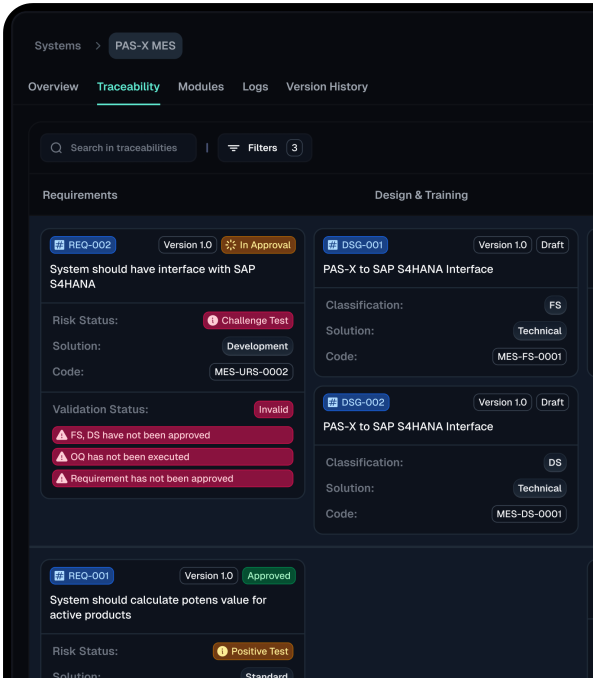
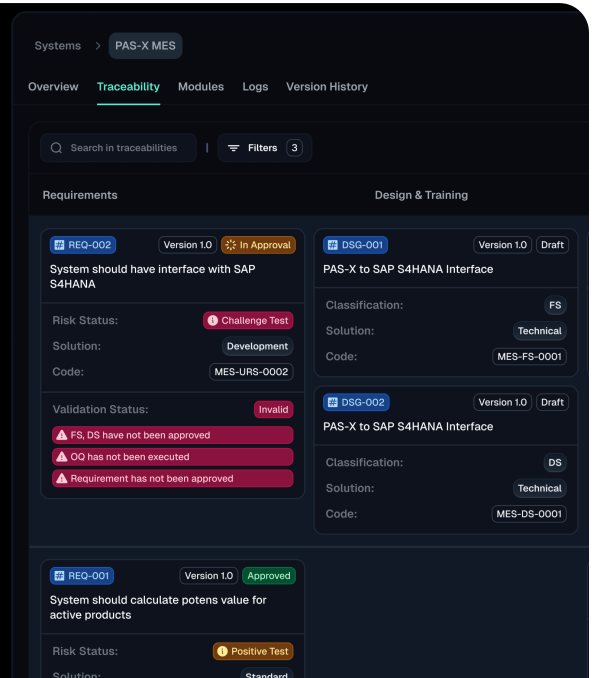
Traceability remains alive.
Risk assessment informs decisions beyond the initial validation project.
Change control identifies validation impact before problems spread.
Test evidence is linked to the right requirement, system, execution, deviation, and approval.
Audit trails are not just present, but reviewable.
Periodic review confirms the current validated state, rather than excavating old assumptions.
AI and automation are governed within the same control model as the rest of the system.
This is validation as an operating model.
Why “Fit for Intended Use” Is Still the Anchor
The move toward continuous control does not erase one of validation’s oldest truths: systems need to be fit for intended use.
That principle becomes even more important as systems grow more complex.
A system cannot be validated meaningfully in the abstract. It must be evaluated against how it is actually used, what process it supports, what data it touches, what decisions it informs, and what failure could mean for product quality, patient safety, data integrity, or compliance.
FDA’s CSA guidance is specifically focused on software used as part of medical device production or quality management systems, but its risk-based assurance logic is directionally important for validation teams across regulated digital environments. It emphasizes establishing confidence in automation and identifying where additional rigor is appropriate. (U.S. Food and Drug Administration)
That is the heart of continuous control.
The question is not whether every function has the same number of test steps. The question is whether the organization can justify the level of assurance based on intended use and risk.
Why Validation Is Becoming Less Document-Centric
Documentation still matters. It always will.
But validation is becoming less document-centric and more relationship-centric.
In a static model, documents often carry the weight of validation. The URS is a document. The test script is a document. The deviation report is a document. The validation summary report is a document. The traceability matrix is often another document trying to hold the family together at dinner.
In a continuous control model, the relationships between records become just as important as the records themselves.
A requirement matters because it connects intended use to risk, design, testing, evidence, deviations, change, and approval.
A test matters because it proves something specific, under controlled conditions, with evidence.
A change request matters because it shows how the validated state was protected when the system moved.
A deviation matters because it reveals where expected control did not behave as planned.
A periodic review matters because it confirms whether the system still remains fit for intended use over time.
This is where many traditional CSV processes struggle. They may produce documents, but the relationships between documents are often maintained manually. When change happens, teams have to reconstruct the validation story by hand.
Continuous control requires that story to remain connected by design.
What Changed in the Industry
Several forces are pushing validation toward an operating model.
First, digital validation tools are becoming more widely adopted. ISPE reported that a 2023 survey found 74% of respondents planned to use Digital Validation Tools for commissioning and qualification by 2024. ISPE also described its 2025 Good Practice Guide: Digital Validation as a practical, risk-based guide for defining, implementing, and managing Digital Validation Tools in regulated environments. (ISPE)
Second, digital validation is no longer only about replacing paper. ISPE notes that Digital Validation Tools can provide real-time visibility into documentation status, link requirements directly to verification tests, streamline document creation and review, support report generation, and enable faster handovers. (ISPE)
Third, AI has changed the level of complexity. ISPE’s 2026 article states that AI is no longer experimental and that the industry now needs to address training data quality, bias, drift, post-deployment monitoring, and human oversight design. (ISPE)
Fourth, the regulatory environment is moving. The European Commission opened a 2025 consultation on revised EU GMP Chapter 4, revised Annex 11, and a new Annex 22 on Artificial Intelligence, explaining that rapid advancement of digital technologies and implementation of AI systems in pharmaceutical manufacturing made updates essential. (Public Health)
Together, these signals point to the same conclusion: validation is becoming a continuous control discipline.
What Did Not Change
The fundamentals did not disappear.
Intended use still matters.
Risk still drives validation effort.
Data integrity still sits at the center.
Human accountability still matters.
Traceability still supports defensibility.
Change control still protects the validated state.
Evidence still needs to be attributable, reviewable, and reliable.
Approvals still need meaning.
Audit trails still need to tell the truth.
The shift from CSV to continuous control is not a rejection of validation fundamentals. It is a stronger way to apply them in modern digital environments.
The danger is not that teams will forget validation. The danger is that they will apply old validation structures to systems that no longer behave in old ways.
Why Change Control Becomes the Center of the Model
If validation is becoming an operating model, change control becomes one of its central organs.
Most validation pain does not come from the original test execution. It comes from what happens after the system begins to change.
A new configuration is added.
A workflow is adjusted.
A report is modified.
An integration is updated.
A vendor releases a new version.
A security control changes.
An AI-assisted feature is introduced.
Suddenly the organization needs to know what was affected.
This is where continuous control either works or collapses.
A strong operating model connects change control to requirements, risks, tests, evidence, deviations, approvals, and periodic review. It allows teams to understand whether a change affects intended use, GxP impact, data integrity, product quality, patient safety, security, or validated functionality.
A weak operating model treats change as a form and validation as an afterthought.
That is how gaps appear. Not with thunder. With one poorly assessed change at a time.
Why Periodic Review Needs to Become More Operational
Periodic review is often where the truth catches up.
If change control has been weak, periodic review becomes archaeology. Teams dig through tickets, approvals, deviations, vendor notes, access reviews, audit trail reviews, incident logs, and old validation documents trying to understand whether the system remains controlled.
In a continuous control model, periodic review becomes more useful because the evidence is already connected.
The review can ask better questions:
Has intended use changed?
Have requirements remained current?
Have repeated deviations appeared in the same area?
Have access controls been reviewed?
Have audit trails been reviewed according to risk?
Have supplier changes affected the system?
Have backup and restore controls been tested?
Have security risks changed?
Have AI or automation features been introduced?
Does the system still remain fit for intended use?
That is a very different posture. It turns periodic review from a compliance ritual into an operating checkpoint.
Where AI-Native Validation Infrastructure Fits
This shift is one reason AI-Native Validation Infrastructure, or ANVI, is becoming an important category concept.
ANVI is not just “VLM with AI.” It describes a broader validation foundation where AI, automation, traceability, change control, testing, evidence, approvals, deviations, and periodic review operate in a connected control layer.
That matters because continuous control cannot be sustained through disconnected documents and manual reconciliation.
A mature ANVI approach helps teams preserve relationships across the validation environment. It can support AI-assisted requirement generation, risk assessment support, test generation, evidence linkage, gap identification, and change impact visibility. But the deeper value is not simply AI productivity. The deeper value is infrastructure.
ANVI supports the transition from validation as a project to validation as an operating model.
It helps answer the question modern teams increasingly face: how do we keep control current while everything around the system keeps moving?
Continuous Control Does Not Mean Autonomous Compliance
One point needs to be clear: continuous control does not mean autonomous compliance.
AI can assist. Automation can accelerate. Digital workflows can reduce manual burden. But regulated organizations still need qualified human judgment, quality oversight, documented justification, and reviewable evidence.
This matters especially as AI becomes part of validation and GMP conversations. The European Commission consultation includes a new Annex 22 focused on Artificial Intelligence alongside the Annex 11 and Chapter 4 updates, with the stated aim of supporting innovation while ensuring regulatory harmonization. (Public Health)
The future is not “let the machine validate itself.”
The future is controlled, traceable, risk-based, AI-assisted validation governance.
That is a smaller sentence than most product brochures would like, but it is a much safer building to stand inside.
What Teams Should Start Changing Now
Life sciences teams do not need to wait for a perfect future-state architecture to start moving toward continuous control.
They can begin with practical changes.
First, review system inventories. Teams need to know which systems are GxP-relevant, which processes they support, which owners are accountable, and which vendors or integrations are involved.
Second, update intended use and requirements. Requirements should reflect how systems operate today, not how they operated at go-live.
Third, connect traceability. Requirements, designs, tests, evidence, deviations, changes, and approvals should be linked in a way that supports impact assessment and audit readiness.
Fourth, strengthen change impact assessment. Every meaningful change should be assessed for validation, data integrity, security, product quality, patient safety, and intended use impact.
Fifth, make risk operational. Risk should guide test scope, audit trail review, periodic review, access control, supplier oversight, and revalidation decisions.
Sixth, improve evidence context. Evidence should not merely be stored. It should be connected to the record, test step, change, deviation, or approval it supports.
Seventh, bring AI under governance. AI-assisted workflows should have defined intended use, review procedures, traceability, approval paths, and lifecycle controls.
Eighth, make periodic review more meaningful. Reviews should confirm current control, not just confirm that documents exist.
These actions are not glamorous. They are the rivets in the aircraft.
The Strategic Value of Continuous Control
Continuous control creates value beyond compliance.
It reduces rework because teams understand impact faster.
It improves audit readiness because evidence is connected.
It supports faster change because risk and traceability are clearer.
It improves collaboration because validation, quality, IT, and operations work from the same control model.
It reduces manual reconciliation because records are no longer scattered across disconnected systems.
It supports smarter automation because AI and testing are governed in context.
It helps organizations scale because validation does not need to be rebuilt from scratch every time something moves.
In a world of frequent system change, continuous control becomes a competitive advantage.
Not because it removes compliance work, but because it makes compliance work less chaotic.
From CSV to Continuous Control
The shift from CSV to continuous control is not a slogan. It is a practical evolution in how regulated organizations manage digital systems.
CSV asks: was the system validated?
Continuous control asks: is the system still validated, and can we prove it?
CSV often centers on project completion.
Continuous control centers on lifecycle confidence.
CSV often produces a validation package.
Continuous control maintains a validation environment.
CSV often treats change as a later event.
Continuous control treats change as part of the operating model.
Both still need discipline. Both still need evidence. Both still need quality oversight. But continuous control better matches the reality of modern digital life sciences operations.
Conclusion
Validation is becoming an operating model because the systems it governs have become living systems.
Cloud platforms change. SaaS vendors release updates. Integrations evolve. AI enters workflows. Data moves continuously. Quality processes span multiple systems. Regulatory expectations are becoming more explicit around lifecycle control, digital documentation, computerized systems, and AI governance.
Traditional CSV still matters, but it is no longer enough on its own.
Life sciences organizations need a model that maintains control continuously. That means connected traceability, risk-based assurance, meaningful change control, contextual evidence, reviewable audit trails, governed AI use, and periodic review that reflects the current state of the system.
This is the path from CSV to continuous control.
And for teams preparing for the next phase of digital validation, it is not only a compliance shift. It is an operating advantage.