Validation teams often talk about testing as if it is the main reason projects slow down.
That is understandable. Testing is visible. It has scripts, steps, evidence, screenshots, deviations, approvals, and deadlines. When a project is late, the test phase is usually where everyone can see the smoke.
But in many life sciences organizations, testing is not the real bottleneck.
The real bottleneck is change.
Change creates the uncertainty that slows everything else down. It forces teams to ask what was impacted, which requirements are still current, which tests need to be revised, which evidence remains valid, which approvals need to restart, which deviations are related, and whether the system is still in a validated state.
Testing is often where the delay appears. Change is where the delay begins.
This matters because regulated digital environments are becoming more dynamic. SaaS applications, cloud platforms, configurable enterprise systems, laboratory software, manufacturing systems, integrations, and automation workflows all evolve more frequently than traditional validation models were designed to handle. Current regulatory and industry guidance also points in the same direction: validation needs to be risk-based, lifecycle-oriented, and capable of maintaining control as systems change. FDA’s Computer Software Assurance guidance describes a risk-based approach for establishing confidence in production and quality system software, while the draft EU GMP Annex 11 states that computerized systems should be validated before use and maintained in a validated state throughout their lifecycle. (U.S. Food and Drug Administration)
For validation teams, this creates a simple but uncomfortable truth: the future of validation will not be won by testing harder. It will be won by managing change better.
Why Testing Gets Blamed First
Testing gets blamed because it is the most measurable part of validation.
A requirement may be vague for months without causing visible panic. A traceability gap may sit unnoticed until someone prepares the validation package. A change impact assessment may be incomplete but still look acceptable until a downstream test fails. Testing is where all of these hidden weaknesses finally show themselves.
A test fails because the requirement was outdated.
A tester gets blocked because the design changed but the test script did not.
A deviation opens because the expected result no longer reflects the configured system.
An approval cycle restarts because someone discovers a missed change.
A validation package stalls because evidence is scattered across systems, folders, emails, and screenshots.
From the outside, this looks like a testing problem. From the inside, it is usually a change control problem wearing a testing costume.
Testing is the messenger. Change wrote the letter.
Why Change Is the Real Bottleneck
Change is difficult because it disrupts relationships.
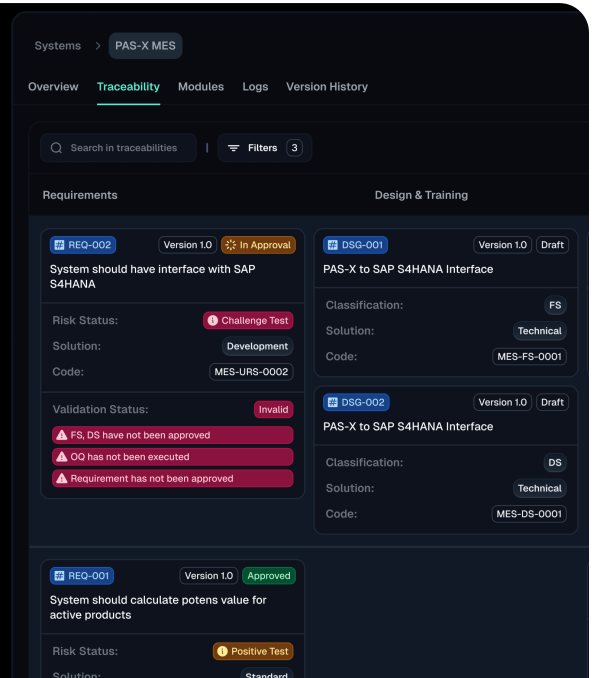
In validation, every critical artifact depends on other artifacts. Requirements connect to designs. Designs connect to tests. Tests connect to execution evidence. Deviations connect to test runs and impacted requirements. Change requests connect to systems, records, actions, risk assessments, and approval decisions.
When a change occurs, the organization needs to understand how those relationships move.
That is where delays accumulate.
The actual technical change may be small. A configuration setting changes. A field becomes mandatory. A workflow step is revised. A user role is updated. A vendor releases a new version. An interface format changes. A dashboard calculation is corrected.
The validation impact can be much larger.
Teams need to know whether the change affects intended use, GxP functionality, data integrity, access control, audit trails, electronic signatures, reporting, evidence capture, or downstream processes. They need to determine whether existing requirements are still accurate, whether risk needs to be reassessed, whether tests need to be updated or re-executed, and whether approvals remain valid.
The draft EU GMP Annex 11 puts this directly into lifecycle language. It states that any change to a computerized system, including configuration, hardware and software components, platform, or operating system, should be made in a controlled manner and that significant changes with possible impact on product quality, patient safety, or data integrity should be subject to requalification and validation.
That is the bottleneck. The hard part is not always executing the test. The hard part is knowing what the change actually touches.
The Cost of Weak Change Impact Assessment
Weak change impact assessment creates validation drag.
When impact assessment is shallow, teams either under-validate or over-validate.
Under-validation creates risk. Teams miss impacted requirements, fail to update test scripts, overlook data integrity controls, or assume evidence remains valid when it no longer supports the current system state.
Over-validation creates waste. Teams retest too much, route too many approvals, revise too many documents, and slow down releases because they cannot confidently separate critical impact from low-risk noise.
Both outcomes are expensive.
A strong change process should answer several questions quickly:
What changed?
Why did it change?
Which system, module, process, or configuration is affected?
Which requirements describe the affected functionality?
Which tests verify those requirements?
Which evidence still applies?
Which risks have changed?
Which deviations or CAPA records are related?
Which approvals are required?
Is revalidation needed, and at what depth?
If teams cannot answer those questions without manual archaeology, change becomes a swamp. Everyone moves, but nobody moves quickly.
Why Modern Systems Make Change Harder
Change has always existed, but modern digital systems make it more frequent and more complex.
A traditional computerized system might have had fewer updates, fewer integrations, and fewer configurable layers. Today’s regulated systems often involve SaaS vendors, cloud infrastructure, APIs, automated workflows, analytics tools, security controls, and cross-functional processes. One update can affect multiple business functions, data flows, reports, permissions, and validation records.
ISPE’s discussion of GAMP 5 Second Edition reflects this shift. It highlights SaaS solutions, systems developed or configured in incremental or iterative ways, cloud service providers, automated traceability, Agile toolsets for requirement changes and deliverables, and searchable tool-based information lifecycles. It also emphasizes that lifecycle activities should be scaled based on GxP impact, complexity, novelty, and the nature of the components and technology involved. (ISPE)
That is the world validation teams now operate in.
The old model assumed change could be contained inside a project phase. The new model requires change to be governed continuously.
Traceability Is the Difference Between Fast Change and Slow Change
Traceability is what makes change manageable.
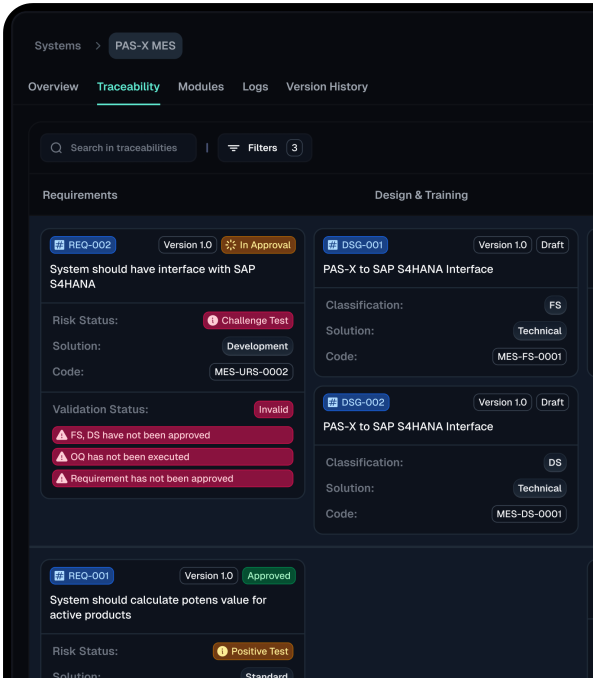
When traceability is strong, impact assessment becomes faster because teams can see the relationships between system components, requirements, designs, tests, evidence, deviations, and approvals. They do not need to reconstruct the validation story from memory. The system already holds the map.
When traceability is weak, every change creates uncertainty.
A simple question like “Which tests need to be re-executed?” becomes a meeting. Then another meeting. Then a spreadsheet. Then a review of the spreadsheet. Then a second spreadsheet because the first one missed something. Eventually, the team executes tests, but the delay was never testing. It was the absence of reliable traceability.
The draft Annex 11 glossary defines change control as ongoing evaluation and documentation of system operations and changes to determine whether actual changes might affect the validated status of the computerized system, with the intent of determining action needed to maintain the system in a validated state.
That definition is useful because it makes change control inseparable from traceability. You cannot determine whether a change affects validated status unless you understand what the validated status depends on.
Why Risk-Based Validation Depends on Better Change Control
Risk-based validation is often discussed as a way to reduce unnecessary testing. That is true, but incomplete.
Risk-based validation only works when the organization understands risk in context. That means risk must be connected to intended use, system functionality, data integrity impact, process criticality, patient safety, product quality, and the specific change being evaluated.
FDA’s CSA guidance describes a risk-based approach to establish confidence in automation used for production or quality systems and to identify where additional rigor may be appropriate. (U.S. Food and Drug Administration) The draft Annex 11 similarly states that Quality Risk Management should be applied throughout the lifecycle and that the validation strategy and effort should be determined based on intended use and potential risks to product quality, patient safety, and data integrity.
This is the regulatory logic validation teams should apply to change.
Not every change requires the same response. A cosmetic label change in a non-critical screen does not deserve the same validation effort as a change to audit trail behavior, electronic signature logic, batch release calculations, or data transfer between systems.
But to scale effort intelligently, teams need reliable impact assessment. Without it, “risk-based” becomes a phrase people say before doing either too much or too little.
The Hidden Validation Work After a Change
A change request is not just a form. It is the beginning of a chain reaction.
Once a change is identified, teams may need to revise requirements, update risk assessments, modify designs, rewrite test scripts, execute regression testing, capture evidence, open deviations, close actions, collect approvals, update traceability, revise validation reports, and prepare the system for go-live or continued use.
This hidden work is where validation timelines expand.
The issue is not that these tasks are unnecessary. In many cases, they are exactly what preserves compliance. The issue is that teams often perform them through disconnected tools and manual coordination.
A change request may live in one system.
Requirements may live somewhere else.
Test scripts may sit in documents.
Evidence may be stored in folders.
Approvals may happen through email or document workflows.
Deviations may be tracked separately.
Periodic review may later ask for the entire history.
When change flows through fragmented environments, validation becomes slower by design. Every handoff becomes a possible leak. Every missing link becomes a small goblin in the machine.
Why “More Testing” Does Not Solve the Bottleneck
When teams are under pressure, the instinct is often to add more testing.
More scripts. More regression. More screenshots. More approvals. More documentation.
Sometimes more testing is appropriate. But more testing does not fix poor change management. It can even make the problem worse by adding volume without improving clarity.
If the team does not know what changed, more tests may still miss the real impact.
If requirements are outdated, more tests may verify the wrong intent.
If traceability is incomplete, more evidence may still fail to prove control.
If deviations are disconnected, more execution may create more review burden.
If approvals are routed without context, more signatures may create bureaucracy rather than confidence.
The better answer is not simply more testing. It is better targeting.
Testing should be driven by risk, intended use, and change impact. ISPE’s GAMP 5 Second Edition discussion supports this broader movement by emphasizing critical thinking, assurance activities based on fit-for-intended-use needs and acceptable risk, and testing methods beyond prescriptive step-by-step scripted protocols. (ISPE)
The goal is not to test less. The goal is to test what matters with better justification.
What Strong Change-Centered Validation Looks Like
A strong change-centered validation model starts before the change reaches testing.
It begins with structured change intake. The change should be described clearly enough to support impact assessment. The affected system, process, configuration, data flow, role, report, interface, or control should be identified early.
Then the change should be mapped to validation objects. Which requirements define the affected functionality? Which designs describe it? Which tests verify it? Which previous test runs and evidence support it? Which deviations or open actions might be related?
Then risk should guide the response. The team should determine whether the change affects product quality, patient safety, data integrity, compliance, security, availability, or intended use. The validation effort should scale accordingly.
Then execution should be targeted. Test scripts should be revised only where needed. Existing evidence should be reused where still valid. New evidence should be captured where the change creates new or altered risk.
Then approvals should be contextual. Reviewers should see not only the changed document, but also the impact logic, linked records, evidence, deviations, and justification for scope.
Finally, the validated state should be updated. Traceability should reflect the current system, not the previous version wearing a new hat.
Why Periodic Review Often Reveals Change Weaknesses
Periodic review is where change control quality gets audited by time.
A team may survive a single change with manual effort. It may survive five changes with heroic coordination. But after a year of incremental updates, the question becomes harder: does the system still remain fit for intended use and in a validated state?
The draft Annex 11 says periodic reviews should verify whether a system remains fit for intended use and in a validated state, or whether changes and revalidation are required. It also says findings should be analyzed for consequences on product quality, patient safety, and data integrity.
This is why weak change control cannot hide forever.
If each change is evaluated poorly, periodic review becomes painful. Teams must reconstruct months of decisions, evidence, deviations, access changes, supplier updates, security patches, and validation activity. If those records are connected, periodic review becomes governance. If they are scattered, it becomes excavation.
Where AI-Native Validation Infrastructure Fits
This is where AI-Native Validation Infrastructure, or ANVI, becomes relevant.
ANVI is not just about adding AI to validation documents. It is about creating a connected validation foundation where systems, requirements, risks, tests, evidence, deviations, changes, approvals, and periodic reviews remain linked and reviewable over time.
For change control, that matters enormously.
An ANVI approach can help teams identify impacted records faster, preserve traceability, support risk-based testing decisions, surface missing evidence, guide reviewers with context, and maintain the validated state continuously. AI can assist with drafting, classification, risk assessment, test generation, and gap detection, but the deeper value is infrastructure: the system keeps the validation story connected as change happens.
This is why the bottleneck conversation is also a category conversation. Traditional validation tools often help manage validation work. Modern validation infrastructure needs to help maintain validation control.
Change is where that difference becomes obvious.
How Teams Can Reduce the Change Bottleneck
Validation teams can start reducing the bottleneck with several practical steps.
First, standardize change impact assessment. Every change should be evaluated against intended use, GxP impact, data integrity, patient safety, product quality, security, interfaces, reporting, access, audit trails, and electronic signatures where relevant.
Second, connect change records to validation objects. A change request should link directly to impacted systems, requirements, designs, tests, test runs, deviations, and evidence. Manual references hidden in comments are not enough.
Third, keep requirements current. If requirements do not reflect the implemented system, impact assessment becomes guesswork.
Fourth, use risk to determine test scope. Testing should be justified by impact and risk, not copied from the last project because that feels safer.
Fifth, preserve evidence in context. Test evidence should be linked to the test run, requirement, deviation, and change where applicable.
Sixth, make approval meaningful. Reviewers should see the full impact story, not just the final artifact.
Seventh, review change patterns over time. Frequent changes to the same module, repeated deviations, recurring test failures, or repeated emergency fixes may signal deeper control issues.
These are not glamorous actions. They are the plumbing of modern validation. And when the plumbing works, the whole building stops smelling like urgency.
The Strategic Value of Fixing Change
When organizations improve change control, they gain more than faster validation cycles.
They gain better release confidence because impact is clearer. They gain stronger audit readiness because evidence is connected. They reduce rework because requirements and tests stay aligned. They improve quality oversight because deviations and actions can be understood in context. They make risk-based validation real because decisions are supported by traceability.
They also create a validation model that can scale.
Modern life sciences systems will not become less changeable. SaaS, cloud, automation, AI, and integrated digital operations will only increase the pace of change. Organizations that treat change as an administrative workflow will struggle. Organizations that treat change as the central validation control point will move faster with less risk.
That is the strategic difference.
Conclusion
Testing is not usually the deepest bottleneck in validation. It is simply where unresolved change becomes visible.
The real bottleneck is the organization’s ability to understand, assess, connect, and control change across the validation lifecycle. As regulators and industry guidance continue to emphasize risk-based assurance, lifecycle control, maintained validated state, and tool-based traceability, validation teams need to rethink where their effort goes. (U.S. Food and Drug Administration)
More testing can produce more evidence.
Better change control produces more confidence.
For life sciences organizations, that distinction matters. The future of validation will belong to teams that can keep the validated state intact while systems evolve. That requires connected traceability, risk-based impact assessment, contextual evidence, controlled approvals, and infrastructure that keeps validation alive through change.
The bottleneck is change.
The opportunity is to control it.