Digital validation in 2026 feels different because the surrounding world has changed.
Life sciences organizations are no longer only digitizing paper records. They are operating across cloud systems, SaaS platforms, integrations, APIs, automation layers, AI-supported workflows, connected manufacturing environments, and expanding data ecosystems. The conversation has moved from “Can we use digital tools for validation?” to “How do we govern a digital validation environment that is always changing?”
That shift is visible across the industry. ISPE’s recent discussion of digital validation in 2026 notes that AI is no longer experimental, Pharma 4.0 has become operational reality, and teams are now validating data flows, integrations, APIs, cloud services, and AI copilots interacting in real time. ISPE also describes Validation 4.0 as designing assurance into digital ecosystems rather than simply improving templates. (ISPE)
At the same time, some of the fundamentals have not changed. Intended use still matters. Risk still drives validation effort. Data integrity still sits at the center. Human accountability still cannot be automated away. Traceability, change control, evidence, and reviewability remain the bones of defensible validation.
So the question for 2026 is not whether validation changed completely.
The better question is: what changed, what stayed the same, and what should life sciences teams do about it?
What Changed: Digital Validation Is No Longer a Side Project
A few years ago, digital validation was often treated as a modernization initiative. It was something forward-looking teams explored to reduce paper, improve efficiency, and make validation execution less painful.
In 2026, digital validation is moving closer to the center of regulated operations.
ISPE reported that a 2023 survey found 74% of respondents planned to use Digital Validation Tools for commissioning and qualification by 2024. ISPE’s Good Practice Guide: Digital Validation was created to provide practical, risk-based best practices for defining, implementing, and managing Digital Validation Tools in regulated environments. (ISPE)
That matters because digital validation is no longer just about replacing paper. The more mature conversation is about how validation data, workflows, evidence, and oversight can become part of daily operations.
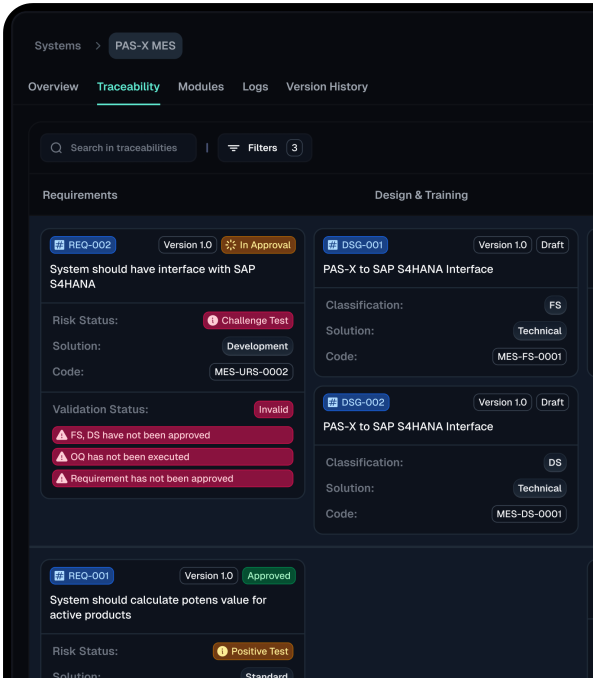
A digital validation tool that only turns paper into electronic forms is useful, but limited. A modern digital validation model should help teams link requirements to verification tests, track status in real time, streamline document creation and review, generate reports, support faster handovers, and improve visibility across validation activity. ISPE’s discussion of Digital Validation Tools highlights exactly these kinds of capabilities. (ISPE)
The change is clear: digital validation has moved from convenience to capability.
What Didn’t Change: Technology Alone Is Still Not the Answer
The industry has become more comfortable with digital validation, but one old truth remains intact: buying software does not automatically create control.
ISPE’s coverage of the Digital Validation guide makes this point directly. Successful implementation requires more than technology. It requires cultural shift, cross-functional collaboration, and alignment with organizational objectives. The goal is not to switch to “paper on glass,” but to think digitally. (ISPE)
That line should be pinned to every validation transformation project like a warning label on a dragon egg.
Digital validation fails when organizations digitize old habits without changing the operating model. If requirements are still vague, traceability is still manually reconstructed, change impact is still assessed through scattered spreadsheets, and approvals still happen without context, the organization has not transformed validation. It has decorated the old process with a new interface.
The tool matters. But the operating model matters more.
What Changed: AI Became Part of the Validation Conversation
AI is now one of the largest changes affecting digital validation.
ISPE describes the 2025 publication of the ISPE GAMP Guide on Artificial Intelligence as a turning point that made the AI conversation more structured. The same article notes that AI systems remain computerized systems, but they operate as interconnected systems of systems embedded across platforms and data streams. It also highlights new AI-related concerns such as training data quality, bias, drift, post-deployment model monitoring, and human oversight design. (ISPE)
This is a major shift.
Validation teams are no longer only asking whether software performs according to a specification. They are also asking how AI systems behave across context, data dependency, changing inputs, and downstream decision impact. The question is no longer only “Did the system produce the expected output?” It is also “Can we explain why this output is trustworthy in this context?”
That makes AI governance a validation issue, not just an innovation issue.
It also strengthens the need for AI-Native Validation Infrastructure, or ANVI. ANVI describes the type of validation foundation required when AI-supported activities, requirements, risks, tests, evidence, approvals, deviations, and change control need to remain connected and reviewable over time.
What Didn’t Change: Intended Use Still Comes First
Even with AI, cloud, automation, and digital ecosystems, intended use remains the anchor.
A system cannot be validated meaningfully in the abstract. It must be evaluated against what it is supposed to do, how it is used, where it is used, what data it touches, what decisions it supports, and what risk it introduces.
This principle is still visible in current regulatory thinking. FDA’s February 2026 Computer Software Assurance guidance describes a risk-based approach to establishing confidence in automation used for production or quality management systems, including identifying where additional rigor may be appropriate and which testing activities may establish assurance. (U.S. Food and Drug Administration)
In practical terms, this means validation teams should not begin with a template. They should begin with intended use.
What process does the system support?
Which functions matter for product quality, patient safety, or data integrity?
Which failures would create meaningful risk?
Which evidence is needed to establish confidence?
Which controls need ongoing review?
Digital tools and AI can support the process, but they do not replace this thinking. Intended use is still the compass. Without it, the validation journey becomes a very expensive walk in fog.
What Changed: Risk Has to Be More Visible and Continuous
Risk-based validation is not new. What changed is the level of visibility expected around risk.
In older validation models, risk assessment was often performed as a document step. It informed the validation package, but it did not always remain active throughout the system lifecycle. In 2026, that approach is increasingly weak.
ISPE’s digital validation discussion notes that risk still drives effort, but now risk needs to be transparent, measurable, and continuously visible across the ecosystem. (ISPE)
The European Commission’s consultation on revised EU GMP Chapter 4, revised Annex 11, and new Annex 22 points in the same direction. The Commission says the Annex 11 revision establishes enhanced requirements for lifecycle management of computerized systems and mandates comprehensive application of Quality Risk Management principles during all steps. It also strengthens expectations around data integrity, audit trails, electronic signatures, system security, supplier oversight, and ongoing maintenance of system requirements. (Public Health)
This is a major signal.
Risk is no longer something teams can bury inside a static document. It needs to guide requirements, testing, supplier oversight, audit trail review, access management, change control, periodic review, and revalidation decisions.
What Didn’t Change: Risk-Based Does Not Mean Less Rigorous
A common mistake is to treat risk-based validation as a shortcut.
It is not.
Risk-based validation does not mean doing less work by default. It means focusing the right level of effort where failure matters most. Sometimes that reduces unnecessary documentation. Sometimes it increases scrutiny. The point is not reduction. The point is proportion.
FDA’s CSA guidance describes a risk-based approach to establish confidence in production and quality management system software and identify where additional rigor may be appropriate. (U.S. Food and Drug Administration) That framing is important. Risk-based assurance is not permission to be casual. It is a method for being deliberate.
In 2026, life sciences teams should stop asking, “How much validation can we remove?”
A better question is, “Where does assurance matter most, and what evidence would make that assurance defensible?”
That question is harder. It is also much more useful.
What Changed: Validation Boundaries Expanded
One of the biggest changes in digital validation is that system boundaries are no longer simple.
A validation team may begin with one system, but the validated process often depends on many connected pieces: cloud infrastructure, vendor releases, identity providers, APIs, data pipelines, integrations, testing tools, reporting layers, and AI-enabled services.
ISPE’s 2026 digital validation article captures this clearly. Teams are no longer validating a single system in isolation. They are validating data flows, integrations, APIs, cloud services, and AI copilots that interact in real time. (ISPE)
That creates a new challenge for validation strategy.
If the organization validates only the application screen but ignores the data flow, the validation may miss the real risk. If it validates only the vendor platform but ignores the configured workflow, intended use may be poorly covered. If it validates only the initial release but ignores future updates, the validated state slowly becomes a historical artifact.
Digital validation in 2026 requires a more connected view of scope.
This is another reason ANVI is becoming an important concept. AI-Native Validation Infrastructure provides a category frame for validation systems that connect the relationships between systems, requirements, risks, tests, evidence, deviations, changes, approvals, and ongoing reviews.
What Didn’t Change: Data Integrity Still Runs the Room
No matter how advanced the technology becomes, data integrity remains central.
The European Commission’s consultation says the revision of Chapter 4 integrates risk-management principles into the data governance system to ensure the accuracy, integrity, availability, and legibility of documents across paper, digital, and hybrid formats. It also says the Annex 11 revision strengthens controls related to data integrity, audit trails, electronic signatures, and system security. (Public Health)
This is the quiet constant underneath every digital validation trend.
AI may change how content is generated.
Cloud may change where systems run.
Automation may change how evidence is captured.
Digital validation tools may change how workflows are executed.
But regulated organizations still need records that are complete, accurate, attributable, legible, contemporaneous, original, consistent, enduring, and available. The technology stack can evolve. The need for trustworthy records does not.
In 2026, data integrity is not a separate compliance theme. It is the foundation of digital validation.
What Changed: Regulatory Expectations Are Becoming More Explicit
The regulatory environment is catching up with the digital reality.
The European Commission consultation on Chapter 4, Annex 11, and Annex 22 was opened because of rapid advancement in digital technologies and the implementation of AI systems in pharmaceutical manufacturing. The Commission says the update is intended to keep GMP guidance clear, practical, and relevant for manufacturers and competent authorities. (Public Health)
The EMA Inspectors Working Group work plan also shows where the roadmap is heading. Annex 11 has a Q4 2026 target date for final text to assure data integrity in the context of GMP, in parallel with Chapter 4 and Annex 22. Annex 22 Artificial Intelligence also has a Q4 2026 target date to assure the use of AI in the context of GMP. (European Medicines Agency (EMA))
That means 2026 is not just another year of digital transformation chatter. It is a year where regulatory guidance is visibly moving toward stronger expectations for lifecycle management, computerized systems, data integrity, AI governance, and documentation control.
Validation teams should not wait for final texts to start preparing. The direction of travel is already clear.
What Didn’t Change: Documentation Still Needs to Tell the Story
Digital validation should reduce documentation burden, but it should not erase documentation discipline.
The documentation story still needs to be coherent. Teams should be able to show what the system is intended to do, why the validation scope is appropriate, how risk was assessed, which requirements were verified, which tests were executed, what evidence was collected, what deviations occurred, how changes were controlled, who reviewed the work, and why the system remains fit for intended use.
What changed is the form of that story.
In a mature digital validation environment, the story does not need to be manually assembled from scattered files. It should already exist through connected records, traceability, evidence, approvals, and controlled workflows. Documentation becomes less about producing a beautiful final binder and more about maintaining an accurate living record.
That is the difference between digital documentation and digital validation.
What Changed: Buy vs. Build Became a Governance Question
The buy-versus-build debate around AI and digital validation has matured quickly.
ISPE’s 2026 article notes that organizations are now asking whether to buy AI-enabled platforms or build AI capabilities themselves. It frames the debate as less about cost and speed on the surface and more about governance maturity underneath. Buying can be faster, but raises questions about transparency, validating updates, drift monitoring, and vendor-driven changes. Building gives more control, but adds responsibility for retraining, performance thresholds, data engineering, bias mitigation, and lifecycle monitoring. (ISPE)
This is one of the most important practical conversations in digital validation today.
A vendor platform may offer speed and embedded controls, but the regulated organization still needs to understand intended use, configuration, validation evidence, update handling, supplier responsibilities, data governance, and inspection readiness.
An internally built system may offer control, but it also increases ownership of design, validation, security, monitoring, maintenance, and lifecycle support.
The right answer is not always buy. It is not always build. The right answer depends on governance maturity.
What Didn’t Change: The Regulated Organization Remains Accountable
Even as vendor ecosystems become more important, accountability remains with the regulated organization.
This is one of the durable truths of validation. A supplier can provide documentation, platform controls, technical support, and validation accelerators. But the regulated company must still define intended use, assess risk, review applicability, approve use, and maintain control in its own operating context.
That principle becomes even more important in 2026 because digital validation increasingly depends on external platforms, cloud services, AI vendors, and integrated tooling.
Supplier documentation is not a magic cloak. It does not make risk disappear. It gives the organization evidence to assess, contextualize, and control.
What Changed: Digital Validation Is Becoming Infrastructure
The biggest shift may be conceptual.
Digital validation is no longer just a workflow category. It is becoming infrastructure.
This is where AI-Native Validation Infrastructure becomes especially relevant. ANVI is not simply another name for VLM or digital validation tools. It describes a broader operating layer for life sciences validation where AI, automation, evidence, traceability, change control, approvals, deviations, and periodic review are connected by design.
The reason this matters is that digital validation in 2026 is no longer about managing one project at a time. It is about maintaining the validated state across systems that keep changing.
A project-based tool helps teams complete a validation package.
A validation infrastructure helps teams maintain control across the lifecycle.
That is the category shift.
What Didn’t Change: Validation Is Still About Confidence
Underneath every trend, every tool, and every new acronym, validation still has the same core purpose.
It exists to establish confidence that a system is fit for intended use and remains controlled in a way that protects product quality, patient safety, data integrity, and compliance.
That confidence cannot come from technology alone. It comes from clear intended use, risk-based assurance, traceable requirements, appropriate testing, controlled change, reliable evidence, qualified review, and ongoing lifecycle management.
Digital validation changes how teams create and maintain that confidence. It does not change why the confidence is needed.
What Life Sciences Teams Should Do Next
The practical next step is not to chase every new tool. It is to assess whether the validation operating model is ready for the current digital environment.
Teams should review whether their validation workflows can handle cloud updates, vendor changes, AI-assisted outputs, cross-system data flows, automated evidence, audit trail review, supplier oversight, and ongoing change impact. They should ask whether requirements remain current, whether traceability is live, whether risk is visible, whether evidence is connected, and whether periodic review can be performed without manual excavation.
They should also assess whether their digital validation approach supports the future direction of regulatory expectations. The European Commission’s consultation points to stronger expectations around computerized systems, data integrity, documentation, AI model validation, performance monitoring, change control, and human review. (Public Health)
That is the map. Teams do not need to guess the weather to know which way the wind is blowing.
Conclusion
Digital validation in 2026 is different.
AI is now part of the validation conversation. Pharma 4.0 is moving from vision to operation. Digital Validation Tools are becoming more widely adopted. Regulatory expectations are becoming more explicit. Validation boundaries now include integrations, APIs, cloud services, data flows, and AI-supported workflows. The buy-versus-build debate has become a governance question. (ISPE)
But the fundamentals still hold.
Intended use matters. Risk drives effort. Data integrity remains central. Human accountability cannot be outsourced to a tool. Documentation still needs to tell a coherent story. Traceability still makes validation defensible. Change control still protects the validated state.
The winning organizations will not be the ones that simply digitize validation documents. They will be the ones that build a validation operating model capable of staying controlled while systems, data, AI, and operations continue to evolve.
That is the real story of digital validation in 2026.
Not everything changed.
But enough changed that standing still is no longer a safe strategy.