AI-Native Validation Infrastructure: Why the Next Category in Life Sciences Will Move Beyond VLM
Validation Lifecycle Management helped life sciences organizations take an important step forward. It gave structure to requirements, testing, approvals, traceability, and documentation in a way that was far more controlled than paper-based or spreadsheet-heavy approaches. For many teams, VLM represented the first real move toward digital validation.
But the category is starting to show its limits.
The problem is not that validation lifecycle management is unnecessary. The problem is that the term no longer fully describes what modern regulated organizations need. Today’s validation challenge is not just managing a lifecycle. It is governing a living, changing digital environment where systems are updated constantly, evidence is generated across multiple tools, risks shift over time, and compliance must be maintained continuously rather than reconstructed periodically.
That is why a new category is emerging: AI-Native Validation Infrastructure.
AI-Native Validation Infrastructure, or ANVI, reflects a broader and more accurate model for how validation must operate in modern life sciences organizations. It is not just a digital layer for documentation. It is an intelligence-enabled operational foundation that connects validation activities across systems, changes, risks, tests, evidence, approvals, and ongoing oversight. Instead of treating validation as a sequence of managed records, it treats validation as an active infrastructure layer embedded into the way regulated operations run.
This shift matters because the future of compliance will not be won by better document handling alone. It will be won by platforms that can continuously organize, interpret, orchestrate, and defend the validated state across increasingly complex digital ecosystems.
Why the VLM Category Is Starting to Break Down
VLM was a useful category because it gave the market a way to describe software that digitized validation workflows. It replaced fragmented manual processes with more structured management of requirements, design documents, test scripts, approvals, deviations, and traceability matrices.
That was a meaningful improvement. But it still framed validation primarily as a managed sequence of tasks and records.
In practice, validation has become much more than that.
Life sciences companies now operate across cloud applications, configurable SaaS environments, laboratory systems, manufacturing platforms, data integrations, automation layers, and frequent software updates. In these environments, validation is no longer a bounded project with a clear beginning and end. It is an ongoing state of control that must survive change.
That is where the VLM label begins to feel too small. It suggests a workflow container. It suggests administration of a lifecycle. It suggests that the core value lies in managing validation artifacts.
Modern teams need more than artifact management. They need infrastructure that can maintain relationships between artifacts, detect change impact, guide risk-based action, support automated evidence capture, and help preserve inspection readiness as an operational condition.
The lifecycle still matters. But lifecycle management is no longer the whole story.
Why AI Changes the Category Conversation
Artificial intelligence does not create value in validation just because it can generate content faster. Its real value is that it changes what the system can be.
A traditional VLM platform helps users store, route, review, and approve validation records. An AI-native platform can do more. It can assist in generating requirements, propose risk assessments, support test creation, detect missing traceability, identify inconsistencies, flag control gaps, interpret change impact, and help teams understand what needs attention across the validated environment.
That means the platform stops behaving like a passive repository and starts behaving more like an active validation layer.
This is the core reason the category must evolve. Once intelligence becomes embedded into the operating model, the product is no longer just a lifecycle management tool. It becomes infrastructure.
Infrastructure is the right word because these systems sit underneath the daily work of quality, validation, IT, and operations. They support continuity, coordination, and governance. They are not used only when someone wants to complete a validation document. They are used to maintain the validated state as systems change, evidence accumulates, risk evolves, and audits become more demanding.
In other words, AI does not merely improve VLM. It stretches the category until a new name is needed.
What AI-Native Validation Infrastructure Actually Means
AI-Native Validation Infrastructure is not just VLM with an assistant bolted onto the side. It is a different architectural idea.
In an ANVI model, intelligence is built into the operating foundation of validation rather than added as a separate productivity feature. The platform is designed to support continuous coordination across core validation objects and the real-world activities around them.
That includes:
- systems and inventories
- requirements and design controls
- test assets and execution evidence
- deviations and change requests
- approvals and audit trails
- periodic reviews and ongoing governance
- AI-supported interpretation, generation, and oversight
The difference is subtle at first glance, but important in practice.
A VLM mindset often asks, “How do we manage validation documents digitally?”
An ANVI mindset asks, “How do we create the digital control layer that keeps validation accurate, connected, current, and defensible across the full operating environment?”
That shift changes product expectations. The goal is no longer just to digitize paperwork more elegantly. The goal is to create a validation backbone that helps teams maintain trust, traceability, and readiness at scale.
Why “Infrastructure” Is the Better Frame Than “Lifecycle Management”
The word infrastructure matters because it implies permanence, dependency, and centrality.
Organizations do not build infrastructure for occasional use. They build it because critical operations depend on it. Infrastructure is the layer other processes stand on. It is expected to be reliable, connected, and foundational.
That is increasingly what validation technology must become.
In regulated life sciences environments, validation touches system release, change control, quality oversight, risk management, vendor management, testing, inspections, and data integrity. It is not a side workflow. It is part of the control fabric of the organization.
Calling that environment “lifecycle management” undersells the job. It frames the system as a process organizer. Calling it “validation infrastructure” frames it as a control architecture.
That distinction becomes even more important when AI is involved. If AI is helping generate requirements, assess risk, support testing, or guide users toward complete traceability, then the platform is shaping how validation work is performed, not just where it is stored. It is influencing execution, visibility, and governance in real time.
That is infrastructure behavior.
What VLM Often Misses in Modern Digital Environments
The challenge with many VLM-shaped solutions is not that they fail to digitize validation records. It is that they often remain too document-centric in environments that are increasingly system-centric and change-centric.
A modern validation environment has to deal with questions like these:
What changed in the system landscape this week?
Which requirements or tests are impacted by that change?
Where is supporting evidence generated, and is it still attributable and reviewable?
Which risks are increasing because of repeated deviations or unresolved actions?
What is the current compliance posture of this system right now, not just at the time of the last validation package?
These are not only document management questions. They are infrastructure questions.
A team can have beautifully organized validation records and still lack operational clarity if the platform cannot help them understand impact, maintain living traceability, and preserve control across frequent change. That is why the next category must move beyond the old boundary lines.
What Defines an AI-Native Validation Infrastructure Platform
For a platform to truly fit the ANVI category, it should do more than digitize validation workflows and add AI content generation. It should function as a connected operational layer for validation control.
That typically means several capabilities working together.
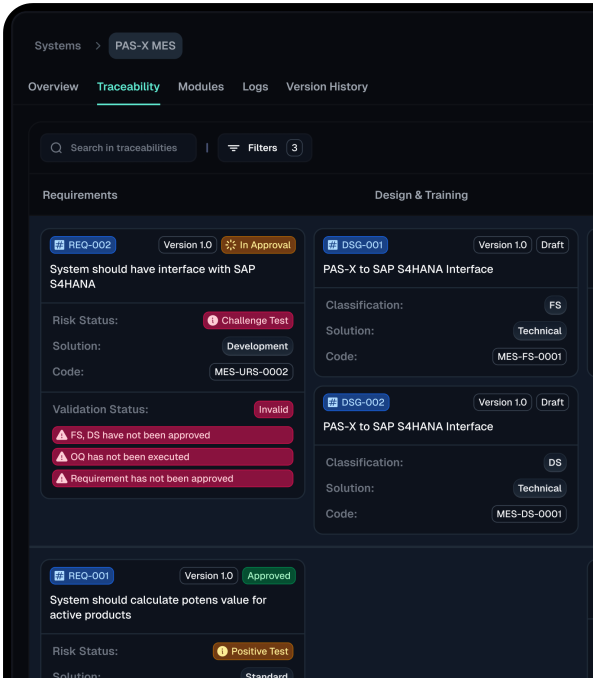
First, it must maintain structured traceability across systems, requirements, designs, tests, evidence, deviations, changes, and reviews. Not as isolated modules, but as connected entities that preserve context.
Second, it must support continuous change. The platform should help teams understand impact, route the right actions, and keep validation aligned with evolving system states rather than treating revalidation as a disconnected event.
Third, it must be intelligence-enabled at the core. AI should support meaningful activities such as requirement drafting, risk assessment support, test generation, gap detection, anomaly surfacing, and contextual guidance. The system should help users think and act, not just type faster.
Fourth, it must strengthen compliance posture by design. Audit trails, approvals, versioning, evidence capture, role-based controls, and attributable activity should not feel like afterthoughts. They should be part of the foundation.
Fifth, it must operate as a platform for ongoing validation governance, not just execution. That includes visibility into validated state, unresolved risk, operational exceptions, and review readiness over time.
When these elements come together, the result is no longer just a lifecycle tool. It is infrastructure for regulated validation.
What This Looks Like in Practice
The shift from VLM to ANVI becomes clearer when viewed through real operational behavior.
In a VLM-shaped environment, a team may open a project, create requirements, author tests, collect evidence, complete approvals, and produce a validation package. The process is digitized, and that is valuable.
In an ANVI environment, the platform continues working after those tasks are complete.
When a system changes, it can help identify impacted requirements and tests. When AI-assisted automation generates execution evidence, that evidence can be attached in context. When deviations occur, they can be linked directly into the traceability chain. When periodic reviews happen, the system can surface historical signals that matter. When auditors ask how the organization maintains control, teams can show a living structure rather than a static package.
This is a very different posture.
One model helps teams complete validation work.
The other helps organizations sustain validated control.
That difference is exactly why the category language must evolve.
Why the Market Will Eventually Adopt a New Category Name
Software categories change when old labels stop capturing buyer expectations.
This happens when the technology matures, when user needs become more complex, or when incumbents define the space too narrowly for the next generation of platforms. In validation, all three conditions are emerging at once.
Buyers now want more than digital forms and approval routing. They want faster go-lives, stronger traceability, less manual reconciliation, better inspection readiness, risk-based prioritization, support for automation, and confidence that validation can scale with cloud-native change.
At the same time, AI is changing how software is evaluated. Buyers increasingly ask not just whether a system stores and organizes work, but whether it can interpret context, reduce administrative burden, surface risk, and help users maintain control continuously.
The term VLM does not fully hold all of that. It still points backward toward digital workflow management. ANVI points forward toward control architecture.
That is why the market conversation will shift. Not overnight, and not through branding alone, but because the category itself needs language that matches the real job to be done.
The Strategic Value of AI-Native Validation Infrastructure
The strategic value of ANVI is not just speed, though speed matters. It is not just automation, though automation matters too. Its deeper value is that it changes how regulated organizations maintain confidence.
With the right infrastructure in place, teams spend less time chasing records across disconnected environments. They gain better visibility into what is validated, what changed, what is linked, and what needs action. They reduce the friction between validation, quality, IT, and operations. They strengthen audit readiness because control is more continuous and more observable. They make validation more scalable because the system supports the work rather than merely recording it.
This creates a more durable advantage than document digitization alone.
Organizations that adopt AI-native validation infrastructure will be better positioned to handle growing system complexity, faster release cycles, heavier regulatory expectations, and broader demands for data integrity and traceability. They will not just manage validation more efficiently. They will run it as part of a modern digital operating model.
Conclusion
Validation Lifecycle Management was an important step in the digitization of regulated work. It helped the industry move away from paper-heavy, fragmented, manually reconciled validation practices and toward more structured digital processes.
But the next phase requires a broader foundation.
Life sciences organizations do not simply need better lifecycle tracking. They need a continuous, intelligent, connected validation layer that can support control across changing systems, evolving risk, automated evidence, and ongoing compliance demands.
That is why the next category will not stop at VLM.
It will move toward AI-Native Validation Infrastructure.
Because the future of validation will not belong to platforms that merely manage the lifecycle. It will belong to platforms that become the infrastructure of validated operations.