Regulated life sciences organizations have long treated audit readiness as a destination. Teams prepare for inspections through focused remediation efforts, documentation reviews, evidence collection, and late-stage coordination. Months of work culminate in a few days of scrutiny.
That model is becoming increasingly difficult to sustain.
Digital systems evolve continuously. Software updates arrive every few weeks. Cloud platforms change underneath validated applications. Artificial intelligence is beginning to influence regulated processes. Suppliers introduce new dependencies, while regulations increasingly emphasize governance, data integrity, and lifecycle control rather than isolated documentation exercises.
The question is not whether an organization can prepare for an audit. It is whether it can demonstrate control every day between audits.
That shift changes audit readiness from a project into an operating model.
Audit Readiness Was Designed for a Different Era
Traditional validation practices evolved when software changed relatively slowly. Enterprise applications were upgraded every few years. Validation documentation reflected that cadence, and inspections naturally focused on whether required documents existed.
The assumption was straightforward. Build the validation package, maintain it carefully, and refresh it whenever significant changes occurred.
For many organizations, that approach worked.
Modern digital environments operate differently. SaaS platforms release features continuously. Infrastructure changes happen automatically. Integrations connect dozens of systems that rarely remain static. Validation documentation can become outdated long before the next scheduled review.
A perfectly organized validation binder can resemble a polished filing cabinet. Everything is neatly arranged, yet some of the information inside no longer reflects operational reality.
That is the bottleneck.
Inspectors increasingly evaluate whether organizations maintain ongoing control of computerized systems rather than simply possessing historical evidence. Recent regulatory direction reinforces lifecycle thinking, risk-based assurance, governance, and data integrity instead of document completeness alone (U.S. Food and Drug Administration; ISPE GAMP® 5 Second Edition; European Medicines Agency).
Static validation asks whether documentation existed.
Continuous readiness asks whether control exists now.
Regulations Are Moving Toward Continuous Assurance
Although regulatory frameworks continue to evolve, the overall direction has become increasingly consistent across agencies.
The FDA’s Computer Software Assurance (CSA) guidance encourages organizations to focus validation effort according to risk, emphasizing critical thinking and objective evidence over excessive documentation (U.S. Food and Drug Administration, Computer Software Assurance Guidance, February 2026).
That does not reduce expectations.
It changes where organizations invest effort.
Rather than producing larger validation binders, regulators increasingly expect companies to demonstrate that systems remain fit for intended use throughout their operational lifecycle. Risk management, change assessment, traceability, documented decision-making, and data integrity remain central expectations.
Similarly, the ongoing revision of EU GMP Annex 11 reflects growing attention to modern digital technologies. Public consultation closed on 7 October 2025, with the European Medicines Agency targeting adoption during Q4 2026. Alongside this work, the draft Annex 22 specifically addresses artificial intelligence in GMP environments, signaling increased expectations around governance, transparency, oversight, and lifecycle management (European Medicines Agency).
Meanwhile, international collaboration between the FDA, EMA, and Heads of Medicines Agencies (HMA) has produced shared AI guiding principles emphasizing trustworthy implementation, human oversight, proportional risk management, and transparency.
The message is remarkably consistent.
The question is not “Where is your documentation?”
It is “How do you know your validated state still exists?”
Why Traditional Audit Preparation Is Breaking Down
Many organizations still respond to upcoming inspections by launching concentrated readiness initiatives.
Teams schedule documentation reviews.
Evidence is collected from multiple repositories.
Validation reports are updated.
Spreadsheets begin multiplying with surprising enthusiasm.
The challenge is not effort. It is timing.
Preparing evidence months after operational events occurred often requires reconstructing decisions, locating historical approvals, and reconnecting information that originally lived across disconnected systems. Documents begin behaving like strangers at a conference. They technically belong to the same organization but require careful introductions before they recognize one another.
Disconnected evidence creates unnecessary risk.
A test record exists in one system. A risk assessment lives elsewhere. Approval emails sit inside personal inboxes. Change records belong to another application. Periodic reviews are maintained separately.
Each artifact may be individually correct.
Collectively, they become difficult to defend.
Inspection readiness becomes an exercise in assembling a puzzle after the picture has already changed.
Continuous Readiness Depends on Connected Evidence
Continuous audit readiness does not mean preparing for inspections every day.
It means operating in a way where evidence naturally accumulates as work occurs.
This distinction matters.
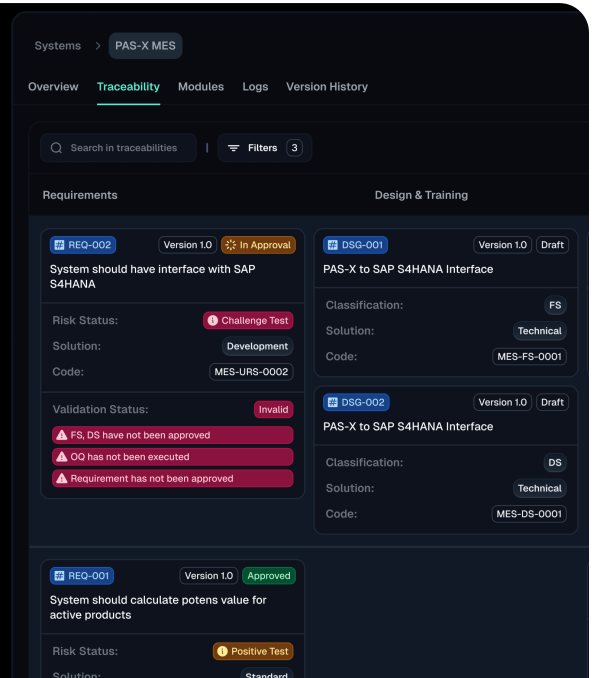
Organizations should not create additional documentation solely to satisfy potential inspectors. Instead, they should ensure that normal operational activities generate traceable, connected, reviewable evidence reflecting actual system control.
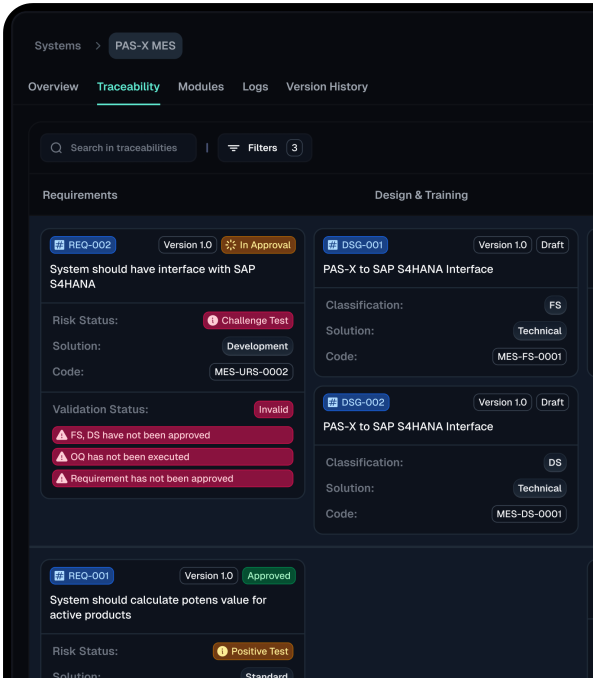
Every approved requirement connects to risk.
Every test connects to requirements.
Every change connects to impact assessment.
Every approval connects to accountable individuals.
Every decision leaves an attributable history.
The audit trail does not wear off.
This represents a shift from documents as isolated deliverables toward evidence as an interconnected relationship. Traceability stops being something reconstructed before inspections and becomes something continuously maintained throughout system operations.
That relationship-oriented perspective aligns closely with modern expectations surrounding ALCOA+ data integrity principles, lifecycle validation, and risk-based quality management.
Human Oversight Becomes More Important, Not Less
Artificial intelligence often enters discussions about validation through automation.
Automation certainly matters.
Governance matters more.
As organizations introduce AI-assisted documentation, testing, impact assessment, or evidence generation, inspectors will reasonably expect organizations to explain how outputs are reviewed, approved, monitored, and controlled.
Human accountability remains essential.
AI assists.
Humans decide.
That principle appears consistently across emerging international AI governance discussions, including the FDA–EMA–HMA guiding principles and draft Annex 22 expectations emphasizing appropriate oversight, transparency, and risk management.
Organizations therefore need more than intelligent tools.
They need governance capable of demonstrating who approved what, why decisions were made, what supporting evidence existed, and how AI-generated outputs were evaluated before becoming part of regulated records.
The question is not whether AI produced an answer.
It is whether qualified people maintained responsibility for accepting it.
This Is Where ANVI Becomes Relevant
Organizations attempting continuous readiness quickly encounter a practical challenge.
Information already exists.
It simply lives everywhere.
Validation documentation resides in document management systems. Change records live inside quality platforms. Configuration information belongs to cloud services. Testing results appear across multiple applications. Risk assessments evolve independently from implementation activities.
This is where ANVI becomes relevant.
AI-Native Validation Infrastructure (ANVI) is not another validation document repository. It represents infrastructure designed to maintain relationships between validation activities as systems evolve. Rather than treating validation as periodic documentation projects, ANVI supports continuous awareness of validation state through connected context, governed workflows, structured traceability, and intelligent assistance.
Importantly, infrastructure does not replace governance.
It strengthens it.
Human reviewers remain responsible for decisions. AI helps identify missing links, summarize evidence, assess potential impacts, surface inconsistencies, and support ongoing validation activities within controlled processes.
The shift mirrors broader digital transformation.
Organizations moved from standalone files toward collaborative platforms.
Validation is beginning a similar transition.
Practical Steps Toward Continuous Audit Readiness
Continuous readiness rarely begins with purchasing new technology.
It begins by changing operational assumptions.
Instead of asking how documentation should be assembled before inspections, organizations start asking how evidence can naturally emerge during daily work.
That perspective influences system design, workflow architecture, and governance decisions.
Change management becomes risk-aware rather than schedule-driven.
Traceability becomes continuously maintained rather than periodically reconstructed.
Periodic reviews become opportunities to confirm operational health rather than discover historical surprises.
Organizations also benefit from reducing manual reconciliation between disconnected systems. Every unnecessary spreadsheet introduces another opportunity for divergence between operational reality and documented evidence.
Small improvements compound.
Connecting approvals.
Standardizing evidence.
Maintaining structured relationships.
Reviewing validation health continuously.
None of these changes appear dramatic individually.
Together, they fundamentally change inspection preparedness.
Continuous Readiness Creates Business Value Beyond Compliance
Audit readiness is often discussed exclusively as a regulatory obligation.
That perspective overlooks its broader operational value.
Organizations with continuously maintained validation evidence spend less time searching for documentation. They resolve deviations faster because relationships between systems, risks, tests, and approvals already exist. Changes become easier to assess because historical context remains immediately accessible.
Confidence increases.
So does organizational agility.
Instead of slowing innovation, well-governed validation enables faster delivery because teams understand their validated state before significant changes occur.
Project thinking asks, “Can we finish validation?”
Operating-model thinking asks, “Can we sustain confidence?”
That distinction influences far more than inspections.
It affects product delivery, quality management, supplier oversight, digital transformation, and executive decision-making.
Ultimately, continuous readiness is not about preparing for regulators.
It is about understanding your own systems well enough that regulatory inspections become a natural consequence of disciplined operations.
Conclusion
Audit readiness is undergoing a fundamental transition.
Organizations are moving from static documentation toward living evidence. From periodic preparation toward continuous assurance. From isolated records toward connected validation intelligence.
Regulatory expectations increasingly reinforce this direction through lifecycle thinking, risk-based assurance, AI governance, and ongoing operational control rather than documentation produced immediately before inspections.
Technology alone cannot create that future.
Governance cannot be delegated.
Human accountability remains the foundation.
But with connected evidence, structured workflows, continuous traceability, and AI-assisted governance operating together, organizations can maintain confidence throughout the validation lifecycle rather than attempting to recreate it before every inspection.
The future of audit readiness is not better preparation.
It is continuous control.