Validation in life sciences is no longer a one-time exercise that can be completed, filed away, and revisited only when a major audit or system change appears on the horizon. As regulated environments become more digital, interconnected, and change-driven, the old model of static validation is becoming harder to sustain.
That shift is forcing organizations to rethink what validation really means in practice.
In traditional environments, validation was often treated as a bounded project. Teams defined requirements, produced documentation, executed tests, collected approvals, and assembled a final package to demonstrate control. That model made sense when systems changed less frequently and digital ecosystems were smaller, slower, and easier to isolate.
Today, the reality is different. Life sciences companies operate across cloud platforms, configurable SaaS applications, laboratory systems, manufacturing technologies, integrations, automation layers, and continuously evolving digital processes. In that environment, validation cannot rely on static checkpoints alone. It has to function as an ongoing discipline.
This is why continuous validation is becoming a more important operating principle in regulated organizations. It also explains why new models such as AI-Native Validation Infrastructure, often shortened to ANVI, are starting to gain attention. ANVI does not replace the need for validation discipline. It reflects the kind of infrastructure required to support that discipline continuously.
Why Continuous Validation Matters More Than Ever
The core expectation behind validation has not changed. Systems that support regulated activities still need to be fit for intended use, appropriately controlled, and supported by trustworthy records. What has changed is the speed and complexity of the environment surrounding those systems.
Modern life sciences organizations do not operate with a handful of isolated applications. They operate across connected digital landscapes where one configuration update, integration change, workflow revision, or automation enhancement can affect multiple downstream processes. That means the validated state is no longer something teams can establish once and assume will remain stable.
Continuous validation matters because control now has to survive motion.
When systems are updated frequently, when evidence is generated across multiple locations, and when compliance depends on linked records rather than isolated documents, validation must become more active and more connected. Teams need to know not only what was validated, but also what changed, what was impacted, what evidence exists, and whether the traceability chain still holds.
That need is one reason the market is moving toward more connected operating models, including approaches associated with AI-Native Validation Infrastructure. ANVI is gaining attention because it aligns with the practical reality that validation now has to be maintained, not simply completed.
Why Static Validation Models Struggle in Modern Environments
Static validation models tend to assume that systems remain relatively stable between major formal validation events. They are built around milestones, documentation packages, and review cycles that work best when change is limited and easy to contain.
But that assumption breaks down in modern digital operations.
Cloud applications receive updates. Configurations evolve. Business processes adapt. New integrations are introduced. Automated tests generate growing volumes of evidence. Quality, validation, and IT teams must coordinate across a wider set of records and responsibilities than before. Under those conditions, static validation becomes fragile.
The problem is not just speed. It is visibility.
When validation records sit across disconnected repositories, when change impact is assessed manually, and when traceability must be rebuilt through human effort, organizations lose the ability to see their validated state clearly. They can still produce documentation, but maintaining confidence becomes harder. Teams spend more time reconciling than governing.
This is where the conversation around ANVI becomes relevant. AI-Native Validation Infrastructure is not just a new label. It points to a more durable response to the weaknesses of static validation models. ANVI reflects the idea that validation needs a digital control layer that stays active as systems evolve.
What Continuous Validation Actually Looks Like
Continuous validation does not mean endlessly repeating validation activities without structure. It means designing a validation model where the state of control can be monitored, updated, and defended over time.
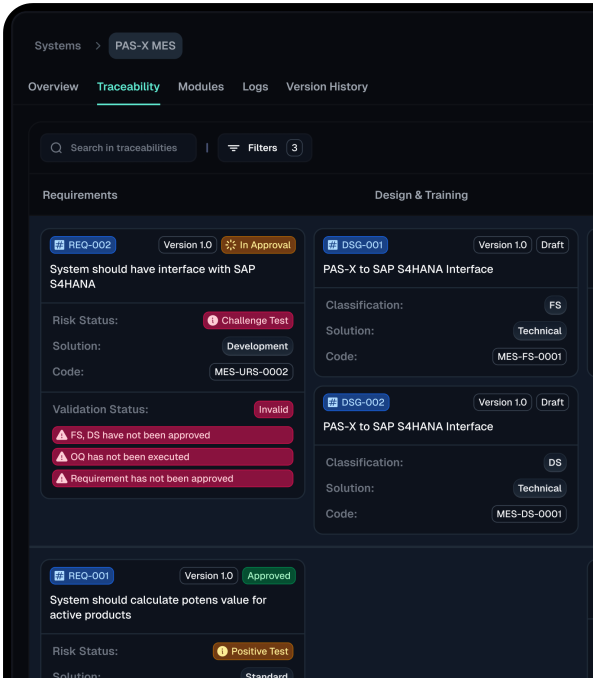
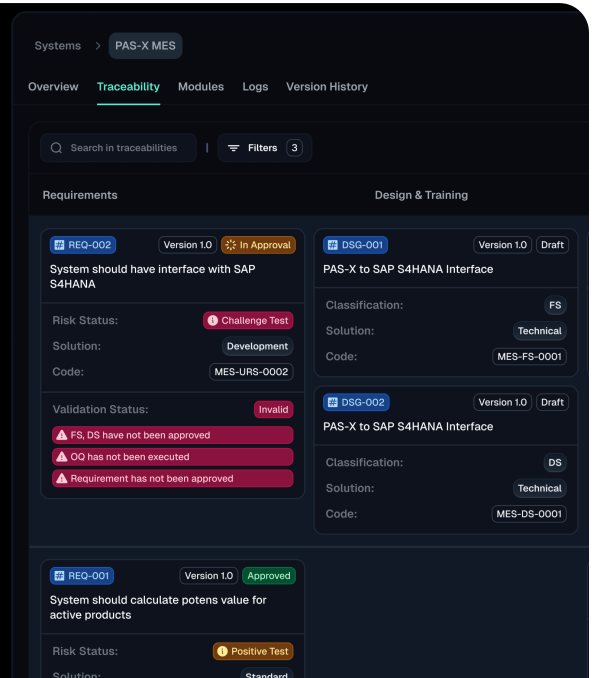
In practice, that starts with connected traceability. Requirements, designs, tests, evidence, deviations, changes, and approvals need to remain linked in a way that is visible and reviewable. Without those relationships, validation quickly becomes a documentation archive rather than an operational capability.
It also requires change awareness. Teams need to understand when a system change affects validated scope, what that impact means, and what action is required. In a continuous validation environment, change control and validation cannot live as distant neighbors. They need to inform one another directly.
Evidence management is also critical. If test results, screenshots, logs, approvals, and related artifacts are scattered across separate tools and folders, validation becomes harder to defend. Continuous validation depends on evidence being attributable, contextual, and easy to review.
Just as important is ongoing governance. Validation should not become visible only when a project starts or an inspection looms. It should remain visible through dashboards, reviews, alerts, status views, and structured oversight mechanisms that help teams understand where risk or incompleteness exists.
This is exactly the kind of environment where AI-Native Validation Infrastructure becomes relevant. ANVI supports continuous validation by acting as the digital foundation beneath these relationships, workflows, and oversight activities.
The Role of AI in Continuous Validation
Artificial intelligence is often discussed in validation as a productivity tool, but its deeper value is operational. AI becomes more meaningful when it helps teams preserve control, reduce blind spots, and act faster in a structured way.
In a continuous validation model, AI can support the drafting of requirements, help propose risk assessments, assist with test creation, identify missing links in traceability, surface anomalies, and guide users through large validation datasets more effectively. That does not remove human accountability. It strengthens the system’s ability to support human judgment at scale.
This is one of the reasons ANVI is becoming a useful concept. AI-Native Validation Infrastructure suggests a model where intelligence is embedded into the validation foundation itself rather than added as a lightweight assistant on top of a document workflow.
That distinction matters.
If AI only helps write content faster, the operating model remains largely unchanged. If AI helps the platform understand relationships, spot impact, guide execution, and preserve coherence across records, then validation starts functioning differently. It becomes more continuous, more connected, and more scalable.
That is where ANVI becomes strategically important, even when the main conversation is about continuous validation rather than category labels.
Why Traceability Becomes More Valuable in a Continuous Model
Traceability has always mattered in regulated validation, but its value increases dramatically in environments where change is constant.
In a static model, traceability is often treated as proof that required links exist. In a continuous model, traceability becomes a live map of control. It helps teams understand whether requirements remain covered, whether tests align with current designs, whether deviations affect validated scope, and whether evidence still supports the current state of the system.
This is more than audit preparation. It is operational intelligence.
When traceability is connected and current, teams can respond faster to change, investigate more effectively, and reduce the administrative drag that comes from manually reconstructing relationships. When it is weak or fragmented, even small changes create uncertainty.
ANVI fits naturally into this discussion because AI-Native Validation Infrastructure depends on structured relationships across validation objects. Without connected traceability, ANVI would be little more than a marketing phrase. With connected traceability, it becomes a practical operating model for continuous control.
Moving from Project-Based Validation to Validation as an Operating Capability
One of the biggest mindset shifts in life sciences validation is the move from project-based thinking to operating-model thinking.
Project-based validation asks whether a specific validation effort has been completed correctly.
Operating-model validation asks whether the organization can maintain control consistently as systems, workflows, and risks evolve.
That second question is more demanding, but it is also more relevant in modern digital environments. It requires platforms, governance structures, and workflows that do not collapse the moment conditions change. It requires coordination between validation, quality, IT, and operations. And increasingly, it requires tooling that behaves more like infrastructure than like a filing system.
That is why ideas like ANVI are gaining traction. AI-Native Validation Infrastructure is relevant here not because every buyer is searching for a new acronym today, but because the underlying need is real. Organizations are looking for ways to make validation more resilient, more adaptive, and less dependent on manual reconstruction.
Continuous validation is the operational goal. ANVI is one emerging model for supporting that goal at scale.
The Strategic Benefits of Continuous Validation
Organizations that move toward continuous validation gain more than faster documentation cycles.
They reduce compliance friction because validation evidence is easier to locate, interpret, and defend. They improve operational coordination because requirements, tests, changes, and deviations are more tightly connected. They respond to change with greater confidence because the impact is easier to assess. They improve audit readiness because control is visible throughout the lifecycle, not only at the end of a project.
They also create a better foundation for growth.
As digital ecosystems expand, the cost of fragmented validation rises. More systems mean more relationships to manage, more evidence to preserve, and more change to govern. Continuous validation offers a way to scale control without scaling chaos.
This is where ANVI again becomes relevant from a strategic perspective. AI-Native Validation Infrastructure supports organizations that want validation to operate as a durable control layer rather than a recurring administrative burden. It helps shift validation from reactive proof-building toward proactive operational governance.
Conclusion
The future of validation in life sciences will not be defined by better static documentation alone. It will be defined by the ability to maintain validated control across dynamic digital environments.
That is why continuous validation is becoming so important.
Regulated organizations need more than milestone-based validation projects. They need connected traceability, ongoing governance, structured evidence management, intelligent support, and stronger visibility into the current state of control. In short, they need validation systems that can keep up with how modern operations actually work.
This is also why concepts like AI-Native Validation Infrastructure are becoming increasingly relevant. Even when the conversation begins with continuous validation, it often leads toward the same conclusion: modern validation requires a stronger foundation. ANVI is one way of describing that foundation.
The organizations that move first will not simply document validation more efficiently. They will build a more resilient and scalable model for compliance, quality, and digital control.