For years, Computer System Validation (CSV) has been synonymous with compliance in life sciences. Organizations built extensive validation packages, generated hundreds of pages of documentation, and measured success by the completeness of the validation binder.
That approach delivered consistency.
It also created a misconception.
Many teams came to believe that more documentation meant better validation. In reality, documentation is evidence of validation—not validation itself.
The FDA’s Computer Software Assurance (CSA) guidance challenges that assumption. Rather than asking organizations to produce less rigor, it asks them to apply rigor differently. The focus shifts from documenting every activity to demonstrating confidence that software is fit for its intended use through risk-based assurance (U.S. Food and Drug Administration).
The question is not whether CSV is disappearing.
It is whether organizations understand what CSA actually changes.
CSV Was Never About Documents. It Was About Confidence.
Computer System Validation emerged to ensure that computerized systems consistently perform as intended in regulated environments. The objective has always been patient safety, product quality, and data integrity.
Somewhere along the way, however, documentation became the visible proxy for confidence.
Validation projects grew larger. Test scripts became increasingly prescriptive. Approval workflows expanded. Organizations often invested enormous effort proving that work had been performed rather than improving the quality of the work itself.
The result was understandable.
When inspections emphasized documentation, documentation naturally became the center of attention.
A polished filing cabinet can certainly impress visitors.
It does not guarantee the software inside the business is actually under control.
CSV asks, “Can we prove validation happened?”
CSA asks, “Can we demonstrate the system is trustworthy?”
That distinction changes everything.
What FDA Computer Software Assurance Actually Introduces
CSA is frequently described as replacing CSV.
It does not.
Computer Software Assurance represents an evolution in how validation activities are planned, executed, and documented. The FDA emphasizes critical thinking, intended use, risk assessment, and objective evidence rather than exhaustive documentation for every verification activity (U.S. Food and Drug Administration, Computer Software Assurance Guidance, February 2026).
Importantly, CSA does not lower regulatory expectations.
Software must still be suitable for its intended use.
Electronic records must still comply with 21 CFR Part 11.
Data integrity requirements remain unchanged.
Instead, CSA encourages organizations to ask better questions.
What functionality directly affects patient safety?
Which failures could impact product quality?
Where should validation effort be concentrated?
The question is no longer “How many test scripts do we need?”
It is “Where does evidence create confidence?”
The Biggest Shift Is From Documentation to Critical Thinking
Perhaps the most misunderstood aspect of CSA is the assumption that it primarily reduces paperwork.
Reduced documentation is a consequence.
Critical thinking is the objective.
Traditional CSV often rewarded consistency through standardized templates and predefined deliverables. While standardization remains valuable, CSA expects organizations to justify validation activities according to system risk, intended use, and business context.
Two applications may perform similar functions.
They may not deserve identical validation effort.
That flexibility reflects modern software development.
Cloud platforms update continuously. Configurations evolve. Integrations expand. Static validation strategies struggle to reflect dynamic operational environments.
Documents can behave like strangers at a conference. Individually complete. Collectively disconnected.
CSA encourages organizations to reconnect validation with operational reality rather than documentation routines.
Risk-Based Assurance Does Not Mean Less Validation
One persistent misconception is that CSA promotes lighter validation.
It promotes smarter validation.
Risk-based assurance directs resources toward functions that genuinely influence regulated outcomes while avoiding unnecessary effort on low-risk features. This principle aligns closely with GAMP® 5 Second Edition, which has long advocated scalable, risk-based validation practices appropriate to system complexity and intended use (ISPE).
Consider two software capabilities.
A dashboard displaying non-critical metrics may require relatively limited verification.
An automated calculation determining product release decisions deserves substantially deeper testing.
Treating both activities identically wastes effort.
Treating both according to risk strengthens compliance.
That is the difference.
CSA replaces equal effort with proportional effort.
The audit trail does not become shorter.
It becomes more meaningful.
Why CSA Fits the Direction of Modern Regulation
CSA is not an isolated initiative.
It reflects broader regulatory evolution.
The revision of EU GMP Annex 11, currently progressing following public consultation that closed on 7 October 2025, similarly emphasizes lifecycle governance, supplier oversight, data integrity, and modern computerized systems, with adoption targeted for Q4 2026 (European Medicines Agency).
Alongside this work, draft Annex 22 introduces expectations for governance surrounding artificial intelligence used within GMP processes. Rather than prescribing technical implementations, it emphasizes transparency, oversight, accountability, and lifecycle management (European Medicines Agency).
International collaboration between the FDA, EMA, and Heads of Medicines Agencies has likewise produced shared AI guiding principles emphasizing trustworthy AI, human oversight, proportional risk management, and continuous governance.
Across these initiatives, one pattern emerges.
Static documentation becomes less important than sustained operational control.
Project thinking becomes operating-model thinking.
The question is not whether validation occurred.
It is whether validation continues.
This Is Where ANVI Becomes Relevant
CSA encourages organizations to generate objective evidence continuously rather than assembling documentation retrospectively.
That sounds straightforward.
Operationally, it is difficult.
Modern validation evidence lives across document repositories, quality systems, testing platforms, cloud applications, configuration databases, change management tools, and supplier ecosystems. Each contains part of the story.
Few contain the whole story.
This is where ANVI becomes relevant.
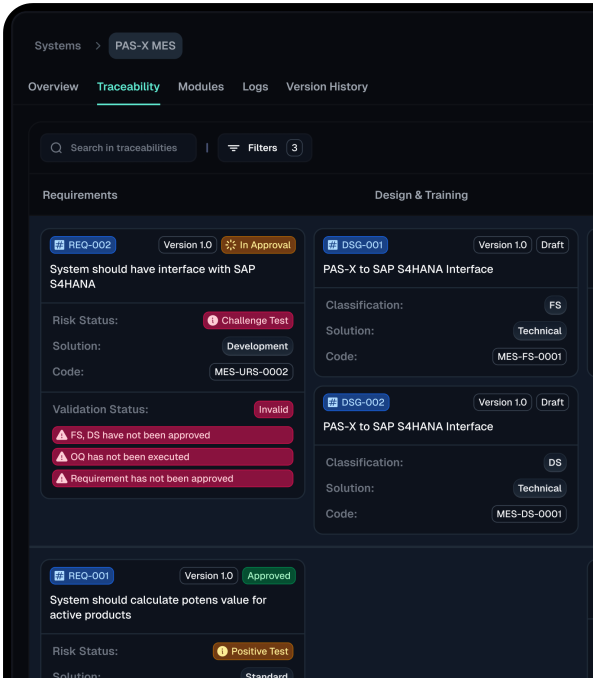
AI-Native Validation Infrastructure (ANVI) is designed around relationships rather than isolated documents. Requirements remain connected to risks. Risks connect to verification. Verification connects to approvals. Changes connect to impact assessments. Evidence remains continuously linked instead of reconstructed before inspections.
Importantly, infrastructure is not governance.
Human accountability remains central.
AI assists by identifying missing traceability, surfacing potential impacts, summarizing evidence, and supporting validation workflows.
Humans evaluate.
Humans approve.
Humans remain responsible.
How Organizations Can Transition from CSV to CSA
Transitioning to CSA rarely begins with rewriting every validation procedure.
It begins with changing how validation decisions are made.
Organizations benefit from examining where documentation exists primarily because “it has always been done that way” rather than because it contributes meaningful assurance.
Many discover opportunities to simplify verification activities without reducing confidence.
Others identify gaps where documentation appears complete but risk assessment remains superficial.
CSA encourages validation teams to begin with intended use, understand critical functionality, perform structured risk assessment, generate objective evidence, and document decisions proportionally.
Technology supports this transition.
Culture determines whether it succeeds.
Validation professionals become less focused on producing artifacts and more focused on understanding software behavior throughout its lifecycle.
That is a significant professional evolution.
The Strategic Benefits Extend Beyond Regulatory Compliance
Organizations implementing CSA thoughtfully often discover benefits extending well beyond inspections.
Validation cycles become more efficient because effort concentrates on meaningful activities rather than repetitive documentation.
Cross-functional collaboration improves because risk discussions involve quality, IT, engineering, and business stakeholders from the beginning rather than near project completion.
Decision-making accelerates.
Confidence increases.
Continuous software delivery becomes more manageable because validation evolves alongside operational change instead of attempting to catch up afterward.
Perhaps most importantly, organizations gain clearer visibility into their validation posture.
Instead of asking whether documentation is complete, leadership begins asking whether systems remain demonstrably controlled.
Those are very different conversations.
One measures paperwork.
The other measures operational confidence.
CSA Does Not Replace CSV. It Modernizes Its Purpose.
The phrase “CSA vs CSV” suggests a competition.
The reality is more nuanced.
CSV established the discipline of demonstrating software suitability within regulated environments. CSA refines how that discipline is applied in increasingly digital, cloud-native, and AI-assisted organizations.
Validation remains essential.
Documentation remains important.
Evidence remains mandatory.
What changes is the balance.
From exhaustive documentation to objective evidence.
From template completion to critical thinking.
From static validation projects to continuous assurance.
That shift is likely to define the next decade of regulated digital validation.
Organizations that understand CSA as a philosophy rather than merely a documentation reduction initiative will be better positioned to adapt—not only to evolving FDA expectations, but also to the broader direction reflected in Annex 11, draft Annex 22, GAMP® 5, FDA data integrity guidance, ISPE Digital Validation, and international AI governance principles.
The future is not less validation.
It is better validation.