For decades, the pharmaceutical industry has been bogged down by the heavy documentation burden of Computerized System Validation (CSV). If you work in quality assurance or IT validation, you know the pain: spending more time taking screenshots and writing extensive scripts than actually testing the software’s quality.
The good news is that the tide is turning. With the FDA’s draft guidance on Computer Software Assurance (CSA), the focus is shifting from “documentation-centric” to “critical thinking-centric.”
But knowing what CSA is differs from knowing how to implement it. How do you move an entire organization from a rigid CSV mindset to a flexible, risk-based CSA approach?
In this guide, we provide a practical roadmap to help you transition from CSV to CSA, ensuring compliance while significantly reducing validation cycle times.
Table of Contents
ToggleWhy the Shift? Understanding the Core Difference
To successfully transition, you first need to understand why regulators are encouraging this change.
The Problem with Traditional CSV
Traditional CSV often treats all system functions with the same level of scrutiny. Whether a feature impacts patient safety or just sorts a list alphabetically, the validation effort is often identical. This leads to “test everything” fatigue, where the goal becomes creating a perfect document rather than ensuring a robust system.
The CSA Solution
Computer Software Assurance (CSA) encourages you to focus your testing efforts where they matter most. It is not about testing less; it is about testing smarter.
- CSV Focus: “Did I document every single step?”
- CSA Focus: “Does this feature impact patient safety or product quality?”
The Tangible Benefits of Adopting CSA
Moving to CSA isn’t just about regulatory compliance; it’s a smart business move.
- Speed and Efficiency: By reducing the need for scripted testing on low-risk features, companies can reduce validation time by up to 50%.
- Higher Quality Assurance: When teams aren’t buried in paperwork, they can spend more time on “destructive testing” (trying to break the system), which uncovers real bugs and critical deviations.
- Cost Reduction: Less time spent on documentation translates directly to lower operational costs.
A 5-Step Roadmap to Transition from CSV to CSA
Transitioning isn’t as simple as flipping a switch. It requires a structured approach. Here is your roadmap:
Step 1: Gap Analysis and Culture Shift
The biggest barrier to CSA is often cultural, not technical. Quality teams are trained to document everything “just in case.”
- Action: Start by reviewing your current validation processes. Identify where your team is over-testing low-risk items.
- Mindset: Encourage your team to ask “Why?” before writing a test script. If the answer isn’t related to patient safety or data integrity, it might not need a formal script.
Step 2: Redefine Your Risk Assessment
In traditional CSV, risk assessments are often complex and rigid. In CSA, your risk assessment needs to be streamlined to separate functions into clear categories:
- High Risk (Direct Impact): Features that directly affect product quality or patient safety. These still require rigorous scripted testing.
- Medium/Low Risk (Indirect Impact): Features that support the process but don’t directly touch the product (e.g., user management, sorting data). These are prime candidates for unscripted testing.
Step 3: Update Your SOPs
You cannot implement CSA if your Standard Operating Procedures (SOPs) still demand traditional CSV deliverables.
- Action: Revise your validation SOPs to explicitly allow for “unscripted testing” and “ad-hoc testing.”
- Guidance: Ensure your SOPs reference the FDA’s CSA draft guidance to give your quality team confidence in the new approach.
Step 4: Implement Unscripted Testing
This is the heart of CSA. Instead of writing a 50-step script for a simple feature, use flexible test management and unscripted testing methods:
- Ad-hoc Testing: The tester explores the system naturally.
- Error-guessing: Testing based on where bugs are likely to hide.
- Documentation: Instead of screenshots for every click, a simple pass/fail summary or a single final screenshot is often sufficient for low-risk items.
Step 5: Vendor Leverage
Most modern software vendors (SaaS providers) already perform extensive internal testing.
- Action: Stop re-testing everything the vendor has already validated during their change control cycles. Review their validation package. If their testing is robust, you can leverage their results to reduce your own workload.
Common Challenges During the Transition
Change is rarely easy. Here are two common hurdles you might face:
Overcoming Resistance to Change
“We’ve always done it this way” is a dangerous phrase. Combat this by running a pilot project. Choose a small, low-risk system update to apply CSA principles and demonstrate the time savings to the leadership.
Addressing the “Auditor Fear”
Many QA managers worry: “Will an auditor accept this?” Remember, the FDA itself is championing this shift. When your documentation clearly links testing effort to risk level (critical thinking), auditors generally respond positively because it shows you understand your system’s impact on patient safety.
Digital Tools: The Enabler of CSA
Trying to implement CSA with paper-based methods or disconnected Excel sheets is difficult. To truly benefit from CSA, you need a centralized platform that supports:
- Risk-based workflows.
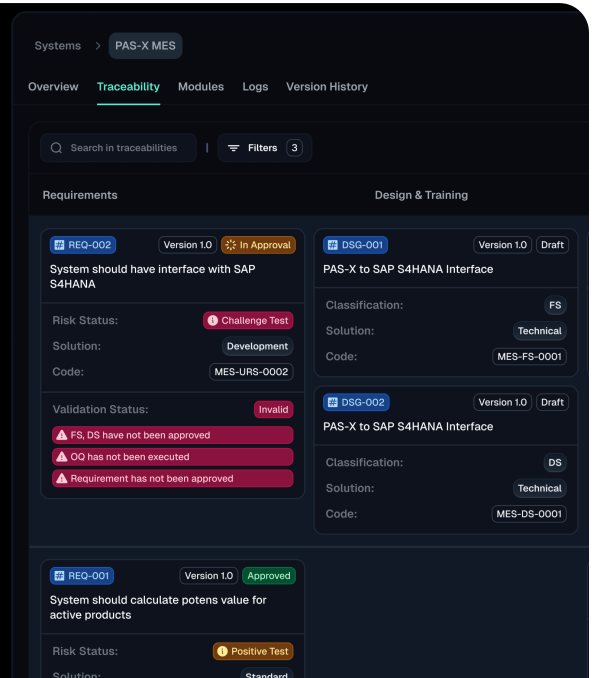
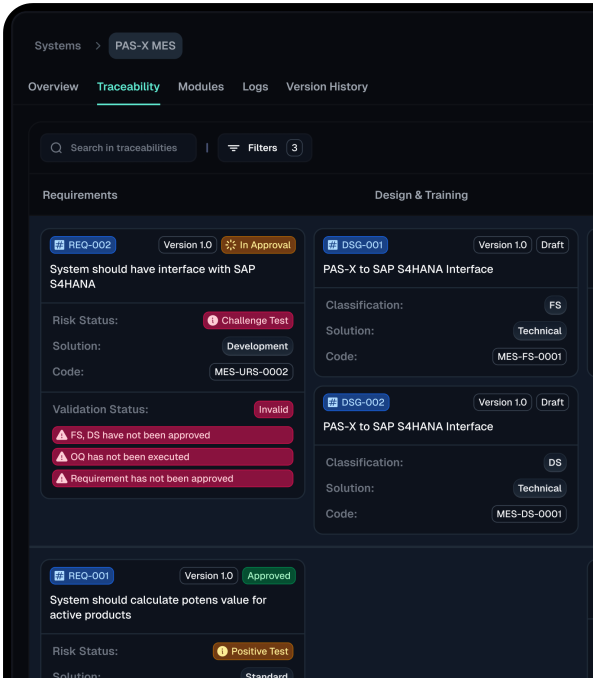
- Traceability matrices that link risks to tests automatically.
- Automated periodic reviews and easy referencing of vendor documentation.
Using a modern, AI-enhanced VLM system allows you to define which tests require scripts and which do not, keeping everything audit-ready without the manual overhead.
Conclusion and Next Steps
Transitioning from CSV to CSA is a journey toward modernizing your quality approach. It allows your team to focus on what truly matters: ensuring your technology is safe, reliable, and effective.