For global life sciences organizations, compliance rarely stops at a single regulatory framework. A pharmaceutical manufacturer may develop products for the U.S. market while operating facilities across Europe. A biotech company may validate the same cloud application for both FDA and EU inspections. Medtech organizations increasingly face similar expectations as their digital ecosystems become more interconnected.
That means one question appears in almost every validation project:
Do we need to comply with 21 CFR Part 11, Annex 11, or both?
The answer sounds simple.
In practice, it often becomes surprisingly complicated.
Many teams treat the two regulations as interchangeable. Others assume they are entirely different. Both assumptions create unnecessary work and, in some cases, unnecessary compliance risk.
The question is not which regulation is stricter.
It is how each regulation approaches trust in computerized systems.
Understanding that distinction changes how organizations validate software, govern electronic records, and prepare for inspections across jurisdictions.
Why Part 11 and Annex 11 Are Frequently Confused
At first glance, the two frameworks appear remarkably similar.
Both govern computerized systems used in regulated life sciences environments.
Both recognize electronic records.
Both require validation.
Both emphasize security, audit trails, user accountability, and data integrity.
Because of this overlap, many validation teams build a single compliance checklist and assume every requirement fits neatly into both frameworks.
It rarely does.
Although the regulations share common objectives, they evolved from different regulatory perspectives.
FDA 21 CFR Part 11 primarily establishes the criteria under which electronic records and electronic signatures are considered trustworthy, reliable, and equivalent to paper records and handwritten signatures (U.S. Food and Drug Administration).
EU GMP Annex 11, by contrast, focuses more broadly on the governance of computerized systems throughout their operational lifecycle within GMP environments (European Commission).
One asks whether electronic records can be trusted.
The other asks whether computerized systems remain under control.
Those questions overlap.
They are not identical.
The Foundations Are More Similar Than Different
Despite the frequent comparisons, organizations should begin with what the regulations share rather than where they differ.
Both expect organizations to validate computerized systems according to intended use.
Both require appropriate access controls.
Both expect secure audit trails where applicable.
Both emphasize data integrity, accountability, and documented procedures supporting compliant system operation.
Neither regulation exists to create paperwork.
Both exist to protect patient safety and product quality through trustworthy digital processes.
This alignment has become even stronger through complementary guidance.
FDA data integrity guidance reinforces ALCOA+ principles for trustworthy records (U.S. Food and Drug Administration). Likewise, EU GMP guidance continues to emphasize lifecycle governance, data integrity, supplier management, and quality risk management.
The audit trail does not wear off simply because an inspection changes continents.
That shared philosophy is why many organizations successfully operate global validation programs serving both regulatory environments simultaneously.
Where 21 CFR Part 11 Places Its Emphasis
Part 11 is often reduced to electronic signatures.
That interpretation misses much of its purpose.
The regulation establishes when electronic records may be considered equivalent to paper records, provided organizations implement appropriate technical and procedural controls.
These expectations include identity verification, authority checks, secure audit trails where required, record retention, system validation, and controls ensuring the authenticity and integrity of electronic records (U.S. Food and Drug Administration).
Part 11 therefore focuses heavily on trustworthiness.
Can the organization demonstrate who performed an action?
Can records be reconstructed accurately?
Can signatures be attributed to the correct individual?
Can changes be detected?
The question is not whether software exists.
It is whether digital evidence can be relied upon.
That perspective continues to influence FDA inspection expectations today, particularly alongside the agency’s guidance on data integrity and Computer Software Assurance (CSA).
Where Annex 11 Expands the Conversation
Annex 11 certainly addresses electronic records.
It also extends significantly beyond them.
The guidance considers computerized systems as operational components of the pharmaceutical quality system rather than isolated repositories for compliant records.
Validation remains central.
Risk management becomes equally important.
Supplier oversight, business continuity, periodic evaluation, incident management, data migration, infrastructure, security, and lifecycle governance all receive explicit attention within Annex 11.
Organizations frequently discover that Annex 11 encourages broader operational thinking than many traditional Part 11 implementations.
Computerized systems are viewed less as software installations and more as living environments requiring continuous management.
Documents stop behaving like isolated islands.
They become connected parts of an operational ecosystem.
This lifecycle perspective aligns closely with GAMP® 5 Second Edition, ISPE Digital Validation principles, and the direction reflected in the ongoing revision of Annex 11, whose public consultation closed on 7 October 2025 with adoption targeted by the European Medicines Agency for Q4 2026 (European Medicines Agency; ISPE).
Where Validation Teams Commonly Get Trapped
Most compliance challenges do not arise because organizations misunderstand individual regulatory clauses.
They arise because teams optimize for documentation instead of governance.
One common trap involves treating Part 11 as a technical checklist.
Organizations enable audit trails.
Configure electronic signatures.
Validate login controls.
Generate documentation.
Project complete.
Except compliance is not complete.
Annex 11 expects organizations to continue governing those systems throughout their operational lifecycle.
Another trap moves in the opposite direction.
Organizations invest heavily in lifecycle governance yet overlook detailed electronic signature controls required for FDA-regulated records.
Neither approach provides complete confidence.
A polished filing cabinet still cannot compensate for weak governance.
Likewise, excellent governance cannot excuse unreliable electronic records.
The question is not which framework receives more attention.
It is whether both perspectives exist together.
Modern Regulations Are Converging Around Lifecycle Governance
The regulatory landscape continues to evolve beyond the original publications of both regulations.
FDA’s Computer Software Assurance guidance encourages risk-based validation focused on objective evidence and intended use rather than excessive documentation (U.S. Food and Drug Administration, February 2026).
Meanwhile, the draft revision of Annex 11 reflects the realities of cloud computing, modern software delivery, and increasingly interconnected digital ecosystems (European Medicines Agency).
Alongside this effort, draft Annex 22 introduces governance expectations for artificial intelligence used within GMP processes, emphasizing transparency, accountability, oversight, and lifecycle management rather than prescribing specific technical architectures.
Internationally, the FDA, EMA, and Heads of Medicines Agencies have also published shared AI guiding principles highlighting trustworthy AI, human oversight, proportional risk management, and continuous governance.
Across all these developments, one direction becomes increasingly clear.
Static compliance is giving way to continuous assurance.
Project validation becomes operational governance.
Evidence becomes relationships rather than isolated documents.
This Is Where ANVI Becomes Relevant
Meeting both Part 11 and Annex 11 expectations becomes increasingly difficult when validation evidence is fragmented across disconnected systems.
Requirements live in one application.
Testing records exist elsewhere.
Risk assessments belong to another platform.
Approvals remain buried inside email conversations.
Every artifact exists.
Few connect naturally.
This is where ANVI becomes relevant.
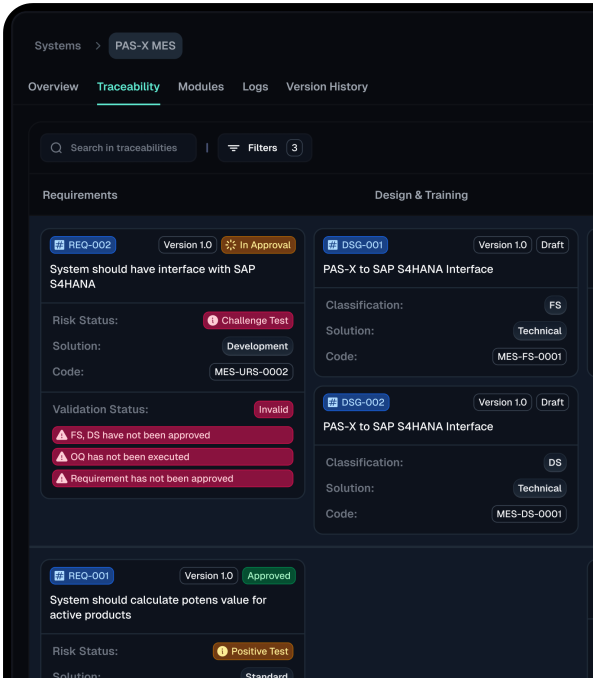
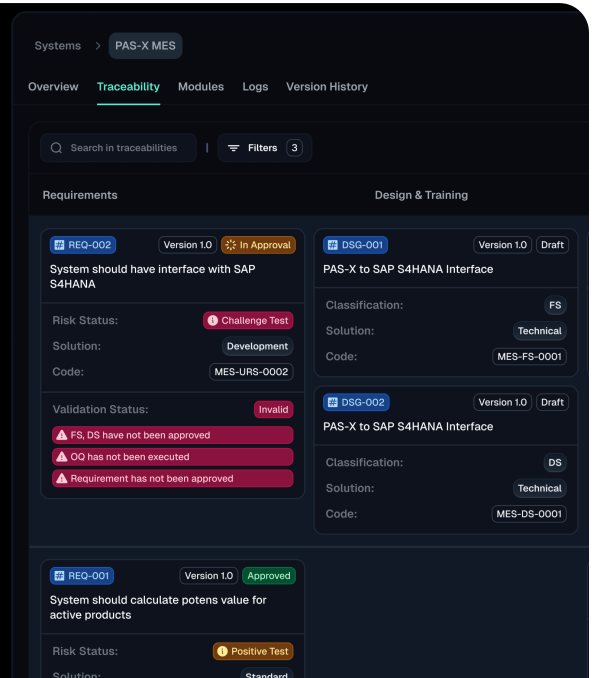
AI-Native Validation Infrastructure (ANVI) is designed to maintain those relationships continuously rather than reconstructing them before inspections. Traceability remains connected across requirements, risk assessments, testing, approvals, changes, and operational evidence while governed workflows preserve accountability throughout the lifecycle.
Infrastructure does not replace regulatory judgment.
AI does not replace validation professionals.
AI assists by surfacing traceability gaps, summarizing evidence, identifying potential impacts, and supporting governed validation activities.
Humans review.
Humans approve.
Humans remain accountable.
Building a Validation Strategy That Satisfies Both Frameworks
Organizations rarely benefit from maintaining separate validation methodologies for Part 11 and Annex 11.
Instead, successful global programs build a unified governance model capable of satisfying both regulatory perspectives.
Validation begins with intended use.
Risk assessment determines verification effort.
Electronic records receive appropriate technical controls.
Lifecycle governance ensures validated systems remain under control as software evolves.
Continuous traceability connects evidence throughout operational activities rather than assembling documentation immediately before inspections.
That approach naturally supports modern validation philosophies reflected in CSA, GAMP® 5, ISPE Digital Validation, and evolving European guidance.
Compliance becomes less about mapping clauses.
It becomes more about maintaining confidence.
That confidence is visible not because documentation is abundant.
It is visible because evidence remains connected, governed, and continuously trustworthy.
Conclusion
Comparing 21 CFR Part 11 and Annex 11 is useful.
Treating them as competing regulations is not.
Both seek trustworthy computerized systems capable of protecting patient safety, product quality, and data integrity. They simply emphasize different dimensions of that objective.
Part 11 focuses on the reliability of electronic records and signatures.
Annex 11 expands the conversation toward lifecycle governance, risk management, and operational control.
The future lies in combining both perspectives.
From checklist compliance to integrated governance.
From isolated documentation to connected evidence.
From validation projects to continuously controlled digital environments.
Organizations that understand this shift will not merely satisfy multiple regulators.
They will build validation programs that remain resilient as software, regulations, and AI-enabled technologies continue to evolve.