Table of Contents
ToggleTop 5 Common Misconceptions About Computer Software Assurance (CSA)
Computer Software Assurance (CSA). You’ve heard the acronym, you’ve read the LinkedIn posts, and you’ve likely heard the rumors.
Since the FDA introduced the draft guidance, the industry has been buzzing with a mix of excitement and confusion. Some think it’s a free pass to stop documenting; others fear it’s a trap set by auditors.
Let’s cut through the noise. It is time to separate fact from fiction and look at what CSA really means for your organization.
Here are the top 5 misconceptions about CSA—debunked.
Myth #1: “CSA Means We Don’t Need Documentation Anymore”
Reality: CSA is not “Zero Documentation”; it is “Right-Sized Documentation.”
This is the most dangerous myth. Some believe CSA allows you to test without recording anything. That is false. You still need to prove your system works. The difference is that CSA allows you to record only what is necessary.
- Old Way (CSV): Taking a screenshot of every single mouse click.
- New Way (CSA): Taking a screenshot only when a high-risk deviation occurs or for a critical final result. You don’t need a screenplay for every scene; you just need to capture the plot.
Myth #2: “CSA is a Brand New Regulation”
Reality: CSA is not a new law; it’s a new approach to existing laws.
You don’t need to wait for a new Code of Federal Regulations (CFR) update. CSA is simply the FDA saying, “Please stop over-interpreting our rules.” It clarifies the existing risk-based approach ingrained in 21 CFR Part 11 and Part 820. The regulatory requirements haven’t changed—the FDA’s patience with excessive paperwork and rigid change management has.
Myth #3: “Auditors Won’t Accept CSA”
Reality: The FDA is the biggest champion of CSA.
Many Quality Managers fear that an auditor will walk in, see unscripted testing, and issue a warning letter. In reality, the FDA developed CSA specifically because they saw companies focusing more on generating paper than on software quality. If your documentation clearly links your testing effort to the risk level (Critical Thinking), auditors will appreciate that you know your system’s impact on patient safety through regular periodic reviews.
Myth #4: “CSA is Only for AI and Complex Systems”
Reality: CSA shines brightest with simple, out-of-the-box software.
You might think, “We just use a simple Spreadsheet or a standard QMS; CSA is for the big tech guys.” Actually, CSA is perfect for widely used, low-risk software (COTS – Commercial Off-The-Shelf). Why write a 100-page script to validate that Microsoft Excel can calculate an average? CSA allows you to leverage the vendor’s testing for these standard functions, saving you massive amounts of time.
Myth #5: “We Need Expensive Software to Do CSA”
Reality: You need a methodology, not necessarily a tool—but tools make it much easier.
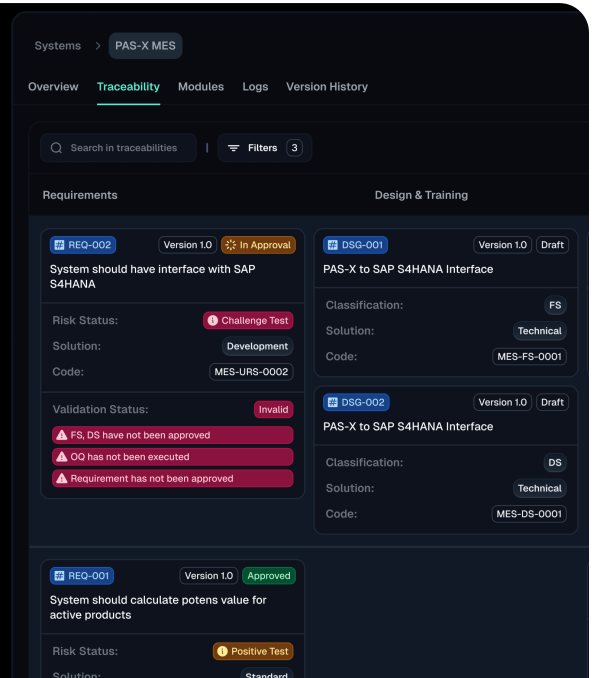
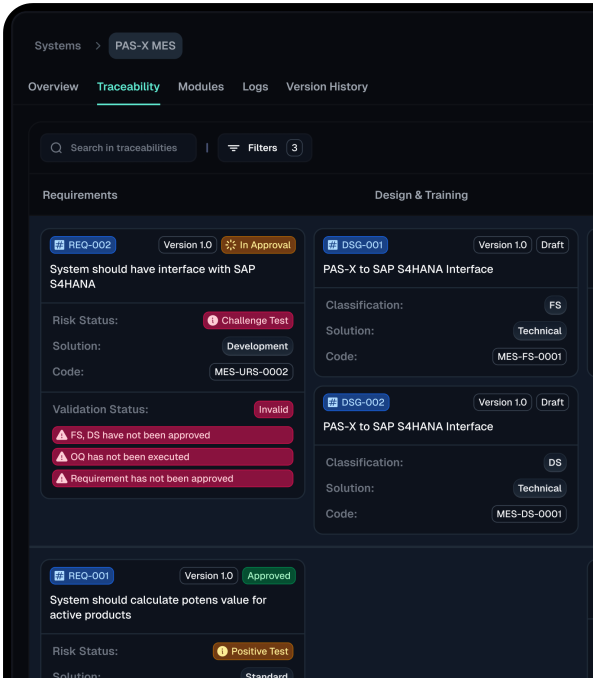
Technically, you could implement CSA principles using paper and pen. You could write “Unscripted Test” on a piece of paper. However, managing a risk-based approach on paper is messy. While you don’t need software to start thinking like a CSA expert, using a digital Validation Lifecycle Management (VLM) system ensures that your risk assessments and test management results are automatically linked, keeping you audit-ready without the headache.
The Bottom Line
CSA isn’t a scary monster, and it isn’t a magic wand. It is simply common sense applied to validation.
Don’t let these myths hold you back. The transition from CSV to CSA is the single most effective step you can take to modernize your quality processes this year.