Digital validation in pharma is no longer a nice to have. It has become the practical way for teams to stay compliant, protect data integrity, and keep up with the pace of modern manufacturing and system upgrades. This shift isn’t just about replacing paper. It’s about giving Quality, IT, and system owners a way to work without the noise, the waiting, and the constant rework that comes with manual processes.
If you work in life sciences, you already know how demanding pharmaceutical validation work can be. The reason more companies are moving to paperless validation in pharma is simple, the old way has reached its limit. Too many delays, too many errors, too many surprises during audits.Below, you’ll find the top reasons pharma teams are adopting digital validation platforms like Validfor, a modern, cloud-based validation system designed to simplify workflow, strengthen compliance, and help companies move faster without adding risk.
1. Keep All Validation Work in One Place
Centralizing documents, requirements, test scripts, reports, and approvals is the fastest way to cut confusion. When teams rely on shared drives, disconnected spreadsheets, or scattered folders, they lose time hunting for the right file or the right version.
Knowledge workers already lose up to 50% of their day to hidden data factories, where they search for information or fix avoidable errors. In pharma, this isn’t just annoying, it slows down releases and opens the door to compliance gaps. Since 83% of organizations say silos hurt performance, it’s clear that validation work needs a single home where everything stays organized.
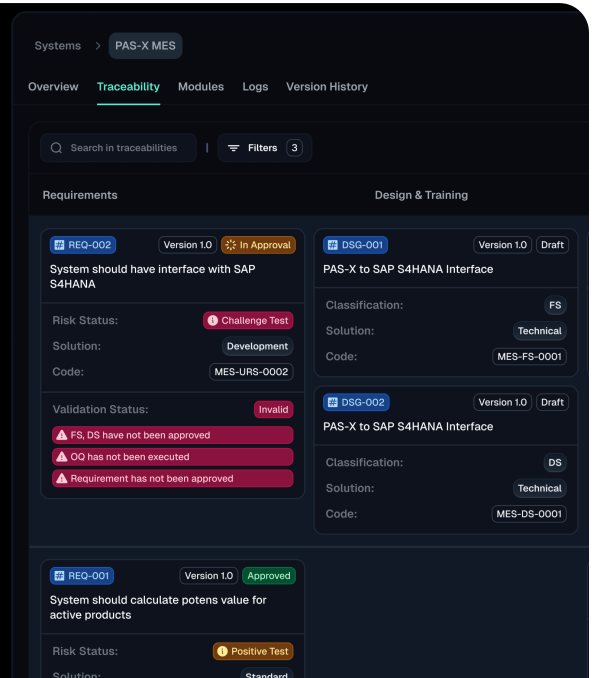
With pharma validation softwares like Validfor, teams stop asking, where is that document? Everything, requirements, risks, specs, traceability, evidence, approvals, lives in one space. It’s easier for everyone to work together, and nothing gets lost along the way.
Real results show up fast, fewer version mistakes, fewer duplicated files, and more clarity about what’s done and what’s pending.
2. Cut Compliance Risks With Standardized Processes
When every system owner, engineer, and QA reviewer follows a different process, inconsistency becomes a real threat. Manual validation often means different templates, different document structures, and different habits from person to person.
A uniform digital workflow fixes this. It sets the path, define requirements, link risks, build test scripts, run execution, collect evidence, collect evidence, close deviations, and sign off. Every project follows the same steps in the right order.Digital validation tools like Validfor make standardization automatic. When the workflow is built into the software, people don’t have to remember the rules, the system guides them.
3. Protect Data Integrity From Manual Mistakes
Paper, shared drives, and uncontrolled spreadsheets make data too easy to alter, overwrite, or lose. In pharma, that risk is far too high. Between 25% and 60% of validation deviations come from human error, and manual processes only increase this exposure.
Regulators know this, too. Data integrity violations are still one of the most common causes of FDA warning letters.
A real example shows how dangerous this can be, the FDA issued a warning letter to Taizhou Kangping Medical Science after discovering they relied on unvalidated Excel sheets with no audit trails. Anyone could change values without detection, a textbook data integrity failure.
Digital systems with version control and audit trails eliminate these weak points. Every edit is tracked, signatures are secure, and no one can accidentally run a test on an outdated form. By using pharmaceutical validation tools designed for structured data, companies protect themselves from the mistakes that manual tracking allows.
4. Shorten Review Cycles and Reduce Busywork
Review cycles should be thoughtful, not slow. But when reviewers must juggle emails, attachments, and unclear changes, everything drags on longer than it should.
AI-enabled validation platforms have shown they can cut document generation time by up to 80% and reduce review cycles from weeks to hours. That’s not an exaggeration, it’s the result of removing unnecessary manual steps.
Digital approvals, pre-built templates, automated routing, and real-time updates keep the process moving. No paper. No scanning. No chasing signatures. No which version should I be reviewing?With paperless validation for life sciences, QA can review changes right away, engineers spend less time formatting documents, and system owners can complete tasks without administrative bottlenecks.
5. Meet Global Regulatory Expectations With Confidence
Regulations aren’t getting easier. FDA, EMA, MHRA, and others continue to tighten expectations for data integrity, risk-based validation, and traceability. Manual systems struggle to keep up.
Poor data integrity can delay market entry and erode margins by nearly 19% for companies that lose exclusivity windows. That’s a huge hit caused by avoidable documentation issues.
The shift toward CSA (Computer Software Assurance) is a perfect example. Regulators want smarter, risk-based validation, not piles of documentation. A digital system automatically links risks to tests, making it easy to show which features are high risk, which are low risk, and how each was tested.With digital validation in pharma, teams spend less time proving compliance and more time maintaining it.

6. Stay Audit Ready at Any Moment
The fear of audits usually comes from one thing, the difficulty of proving what happened and when it happened. Paper trails get messy. Manual logs get lost. Version histories get confusing.
Two of the top FDA findings today are Lack of Audit Trail Review and Inadequate Controls, both of which are made worse by manual documentation.
Digital systems fix this by capturing every step. Reviewers see who did what, when they did it, what changed, and why. Audit trails become simple history views rather than detective work.With an electronic validation system for life sciences like Validfor, teams can pull complete records instantly. During an audit, this is priceless. No scrambling. No I think the file is on the shared drive. Just clear, clean proof.
7. Reduce Human Error in Critical Tasks
Even the most careful teams make mistakes, especially when handling repetitive tasks like attaching evidence, updating statuses, or entering execution results.
Nearly 40% of critical GMP findings are tied to human factors like missing dates or misplaced pages. This isn’t about lack of effort. It’s about the limits of manual workflow.
Digital tools act like guardrails. If a signature is missing, the system doesn’t allow progression. If a required field is empty, the form can’t be submitted. If a document isn’t the latest version, it can’t be used.This approach turns pharmaceutical validation into a safer, more controlled process where errors are caught before they become deviations.
8. Use Automation to Maintain Validation Status
Staying validated over time, especially as systems change, is just as important as the initial validation. Manual reminders and disconnected spreadsheets make it easy to overlook scheduled reviews or revalidation steps.
Paperless systems reduce the total effort required to maintain validation status automation handles reminders for periodic reviews, schedules, status tracking, and flags when something requires action. Automation handles reminders, schedules, status tracking, and flags when something requires action.With a digital validation system for life sciences like Validfor, teams stay in control without relying on memory or manual calendars.
9. Help Quality and IT Teams Work Together More Easily
Miscommunication between IT, QA, and system owners creates delays and unnecessary back-and-forth conversations. A change in one document often breaks another, and without automatic notifications, people may not know the update happened.
In life science industry, these silos are one of the biggest hidden costs, and they slow down validation more than most teams realize.
Digital validation tools solve this with shared dashboards, change alerts, comment threads, and status visibility. When IT updates a Functional Spec, QA gets notified to update the test script. When QA finishes a review, system owners see it instantly.
A single source of truth keeps everyone aligned, even across time zones or remote teams.
10. Scale Validation Efforts as Your Operations Grow
As companies expand, validation requirements multiply. New equipment, new digital systems, new automated instruments, new manufacturing lines, everything needs validation.
With a digital platform, scaling doesn’t mean adding chaos. It means creating more projects within the same organized environment. Templates, workflows, risk libraries, and automated processes grow with you.For companies planning new products or modernizing operations, paperless validation systems like Validfor becomes essential as soon as complexity rises.
11. Adopt Secure, Cloud-Based Validation Practices
The industry is moving toward cloud platforms because they’re secure, fast to deploy, and easy to access. Cloud and SaaS now make up more than 70% of validation software revenue, reflecting a major shift away from on-premise tools.
Real examples already show why. Remote teams can collaborate in real time. QA in one country can review a protocol executed in another. System owners don’t need VPNs or slow shared drives.
Cloud validation systems like Validfor also support role-based permissions, encrypted storage, and ongoing security updates, far stronger protection than shared folders or paper binders.
12. Lower Costs by Preventing Rework and Delays
Paper-based validation looks cheap on the surface, but the hidden costs tell a different story. Delays, rework, repeated testing, lost documents, and inefficient review cycles add up fast.
Digitizing validation can save around 65% of total validation costs, not just by eliminating paper but by stopping errors that force entire tests to be redone.
A simple example, if a test is performed using Version 1 of a protocol after Version 2 has already been approved, the entire test becomes invalid. A digital system prevents this by locking outdated versions.
Fewer mistakes mean lower costs and faster release timelines.
13. Connect Validation With Your Existing Quality Systems
Validation doesn’t stand alone. It connects to QMS, LIMS, ERP systems, equipment records, and manufacturing platforms. When these systems don’t talk to each other, data must be copied manually, a slow, error-prone process that wastes time.
Integration removes this friction. When validation data flows smoothly into QMS or LIMS, tasks become consistent, and duplicate work disappears.
Pharma validation softwares like Validfor are designed to be part of a bigger ecosystem, not a standalone island.
14. Strengthen Change Control Across the Lifecycle
Change control is one of the hardest parts of validation, especially when systems have many linked requirements and tests. In manual setups, assessing the impact of a change usually involves guesswork and outdated spreadsheets.
Digital systems link change control management directly to validation impact assessments. When a sensor, form, or workflow changes, the system shows which requirements and test scripts are affected.
Examples from the industry show how powerful this is, if a Temperature Sensor changes, the system can reveal the exact 3 requirements and 5 test scripts that must be updated. Nothing gets missed.This level of clarity turns validation in the pharmaceutical industry into a predictable, well-controlled process rather than a risky one.
15. Keep CSV and CQV Activities Consistent Over Time
For years, CQV (equipment validation) and CSV (computerized software validation) were handled in separate silos. As equipment gets smarter and more integrated, that separation no longer makes sense.
The industry has already moved toward unified lifecycle management. Modern platforms let teams validate hardware and software in the same record, even for complex devices like smart pumps.
This ensures consistent validation across installation, configuration, testing, and long-term maintenance. With a digital approach, updates, patches, and process changes stay controlled from start to finish.
This is how digital validation for life sciences keeps teams aligned across the full lifecycle.
Why Validfor Is the Right Choice
Every point above reflects the real challenges pharma teams face every day.
Validfor was built for these exact challenges:
- It centralizes all validation work so teams always know where things stand.
- It creates consistent, compliant workflows aligned with global regulatory expectations.
- It protects data integrity with complete version control and structured records.
- It keeps teams audit-ready with full traceability.
- It supports lifecycle validation across CSV, CQV, and everything in between.
- It offers secure, cloud-based access, role controls, and rapid deployment.
- It integrates with the systems you already use.
- And it scales as your operations grow, without creating more work.
If your team still uses paper, shared drives, or spreadsheets for validation, the risks and workload will only increase over time.
A modern solution like Validfor gives you the control, speed, and confidence you need.