Low-code platforms promise that business teams can build workflows in days instead of waiting months for software development.
That promise is often true.
It also changes where software behavior is created. Logic moves from source code into visual flows, formulas, rules, connectors, permissions, templates, and citizen-developer decisions. The application may be easy to build and difficult to govern.
The question is not whether low-code is “real software.” It is whether the configured solution is fit for its intended GxP use and remains controlled as people change it at operational speed.
Low-Code Changes the Validation Boundary
Current EU GMP Annex 11 applies to computerized systems used in GMP activities regardless of development style. It expects risk-based lifecycle validation, traceable requirements, controlled configuration and change, appropriate supplier assessment, security, audit trails, and periodic evaluation (European Commission).
FDA’s final Computer Software Assurance guidance, issued February 3, 2026, focuses on intended use, process risk, proportionate assurance, and objective evidence for covered medical-device production and quality-system software. It recognizes automation tools, cloud computing, and varied testing methods within the risk framework (U.S. Food and Drug Administration).
Low-code does not remove validation. It redistributes responsibility among the platform provider, tenant administrator, solution maker, process owner, IT, and Quality.
The platform may be qualified and well controlled. The application built on it can still route the wrong approval, expose the wrong record, or calculate the wrong result.
Why “It’s Only Configuration” Is the First Trap
Visual builders make logic accessible. They also make material change look harmless. Dragging a connector or editing a condition can alter record flow as decisively as changing conventional code.
The second trap is blurred ownership. A subject-matter expert creates a helpful workflow, users adopt it, and Quality learns about it after it has become operationally essential. Innovation succeeds before governance arrives.
The third trap is platform inheritance. Teams assume that supplier certifications and platform validation cover every tenant application. Supplier evidence supports common services and controls; it does not prove the customer’s intended use, local configuration, data model, roles, or integrations.
The fourth trap is uncontrolled promotion. Makers edit production directly because the tool allows it. The platform records a change, but there was no approved requirement, risk assessment, or verification.
Classify Platforms and Applications Separately
Assess the platform’s GxP role, architecture, supplier controls, security, release process, availability, backup, auditability, and lifecycle. Then assess each configured application by intended use and risk.
A simple notification app may support a process without maintaining a regulated record. A deviation workflow, equipment-status app, calculation tool, or approval application may directly affect product quality or quality-system records. Their assurance should differ.
Define application tiers using decision influence, data criticality, automation level, complexity, integrations, configurability, user population, and detectability of failure. Avoid labeling the entire platform either GxP or non-GxP without examining use.
Maintain an inventory of applications, owners, environments, platform version, critical components, interfaces, and status. Citizen development without inventory is just shadow IT with better colors.
Include prototypes and personal productivity apps in discovery. A low-risk experiment can become a de facto production control when colleagues begin relying on its output. Define the point at which experimental use must stop or enter governed onboarding.
Govern Makers as a Controlled Development Community
Define who may build, review, test, approve, promote, administer, and retire applications. Training should cover platform skills, GxP principles, data integrity, secure design, testing, documentation, and change control.
Use development standards for naming, reusable components, error handling, logging, permissions, data retention, integrations, and user messages. Provide approved patterns for common controls such as electronic approval, audit history, and exception routing.
Separate maker and production privileges where risk warrants it. A creator should not automatically approve and deploy a critical workflow. Use peer review and Quality involvement proportionate to the application’s role.
Support makers with a center-of-enablement model rather than a distant prohibition. Governance that takes six weeks to answer a low-risk question will be replaced by a workaround before lunch.
Certify makers by capability and risk tier. Building a local reminder flow does not confer authority to design an electronic approval workflow. Advanced privileges should require demonstrated platform competence, GxP understanding, and ongoing participation in controlled practices.
Make Requirements and Logic Visible
Document intended use, users, records, decisions, data flows, rules, interfaces, failure modes, and prohibited uses. Requirements can be concise, but they must be sufficient to support risk analysis and assurance.
Export or otherwise preserve the configured logic in a controlled, comparable form. Screenshots alone may not capture hidden conditions, inherited settings, component versions, or environment variables.
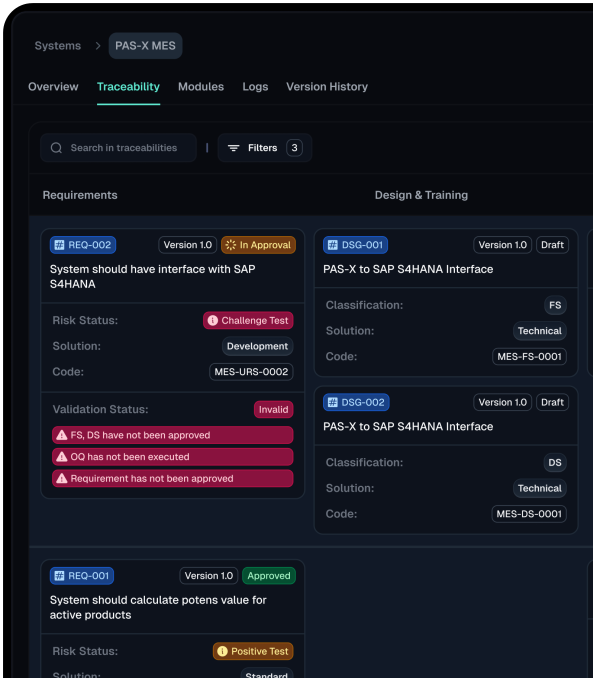
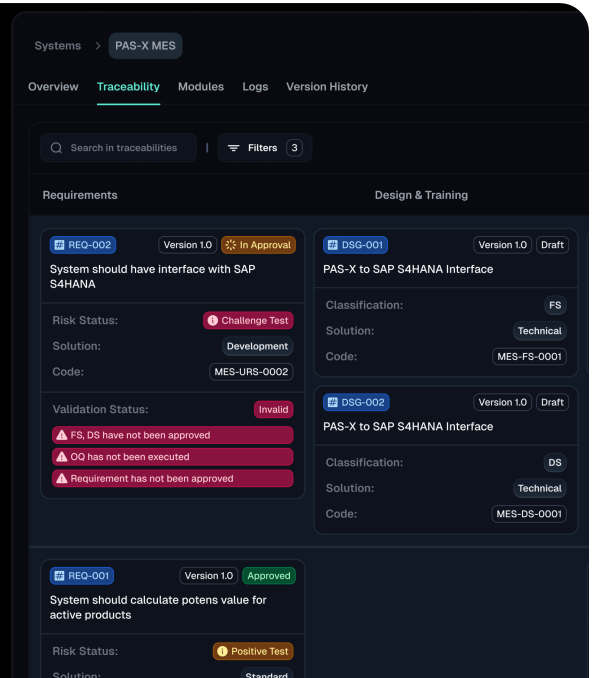
Trace critical requirements to flows, formulas, roles, connectors, and tests. Identify reusable platform controls and customer-specific controls. If the application relies on a shared component, record which version is deployed.
Keep configuration synchronized with the approved description. A visual diagram that reflects last quarter’s workflow is still obsolete documentation, only more attractive.
Control reusable components as shared products. A calculation module, connector, approval component, or audit-history pattern may support many applications. Version, test, approve, and communicate changes so each consuming application can assess impact without repeating all platform-level work.
Test by Risk and by Failure Mode
Use scripted testing for critical deterministic rules, approvals, calculations, permissions, record creation, and interfaces. Use exploratory or unscripted testing to challenge navigation, unexpected sequences, concurrent actions, error handling, and realistic user behavior.
Automate stable regression where the platform supports it, but assess the testing tool and environment for their intended use. Supplier tests can support platform-level confidence when reviewed and applicable.
Challenge negative paths: unauthorized access, incomplete data, duplicate submission, connector failure, unavailable reference data, rejected approval, version conflict, and recovery after interruption.
The evidence record should capture intended use, risk, assurance performed, results, issues, conclusion, and responsible reviewers. A screen recording can supplement evidence; it does not replace a clear decision.
Control Platform Releases and Component Drift
Low-code platforms evolve frequently. A supplier update may change connectors, formulas, user interface behavior, security, APIs, or deprecated components across many applications.
Maintain a dependency view from platform services and shared components to applications and GxP functions. Triage release notes, security advisories, and deprecation notices by affected use.
Use a sandbox or validation tenant when available. Execute targeted regression on critical applications before or immediately after controlled release according to supplier capability and risk. Monitor production behavior where customers cannot control timing.
Detect local drift as well. Compare approved and production configurations, review maker activity, and prevent direct production editing except through controlled emergency procedures.
Plan for platform exit. Preserve application logic, data, metadata, attachments, audit history, and dependency documentation in forms that support migration or archival. A visual flow locked inside a supplier tenant is not a durable system specification.
This Is Where ANVI Becomes Relevant
AI-Native Validation Infrastructure becomes relevant when low-code applications are represented through connected requirements, components, configurations, releases, tests, makers, changes, and approvals.
ANVI can assist by interpreting exported flows, detecting configuration differences, identifying affected applications, proposing tests, and assembling release-impact evidence. Humans decide classification, risk, acceptance, deployment, and continued use.
AI-generated application logic deserves the same controls as human-created logic. A natural-language prompt that builds a workflow can accelerate development; it cannot approve its own requirements or validate its result.
Connected governance lets citizen development remain fast without making evidence an afterthought.
A Practical Low-Code Governance Model
Start with the platform and application inventory. Identify unregistered production apps, critical records, integrations, owners, maker privileges, and direct-edit capability.
Create application tiers with standard deliverables and approval paths. Provide lightweight templates for intended use, risk, logic description, test evidence, release, and retirement. Reserve deeper rigor for higher-consequence applications.
Pilot the model with one new application and one existing critical app. Baseline configuration, close access gaps, test failure modes, and exercise platform-release impact assessment.
Then measure flow and control: unregistered apps, direct production edits, overdue owner reviews, failed connectors, release-assessment time, reusable test coverage, and defects escaping into production.
Review applications periodically for continued need. Low-code makes creation inexpensive, which can make retirement culturally difficult. Remove redundant apps, revoke unused connectors, archive required records, and close permissions before the platform becomes a digital shed of forgotten workflows.
Include platform governance in management review. Track maker population, critical-app ownership, unsupported components, supplier changes, security exceptions, recurring defects, and capacity constraints. The portfolio may begin as departmental productivity and quietly become regulated infrastructure; oversight should notice before the outage does.
Conclusion: From Citizen Development to Accountable Automation
Low-code and no-code platforms can reduce delivery time and bring process knowledge closer to solution design. They also place software decisions in more hands.
The core shift is from code-centric control to behavior-centric assurance, from platform certificate to application evidence, and from citizen developer to accountable maker. Speed becomes sustainable when configuration, change, and human approval remain visible.
The platform stays accessible. The regulated operating model becomes deliberate, scalable, and defensible.
That is the difference between rapid building and sustainable regulated automation.